Showing posts with label Activism. Show all posts

December 15, 2014

Teaching Through Trauma: Sexual Violence and Sex Positive Parenting


You may recall that over the summer I caused a bit of a stir with my article, "Sex Positive Parenting, or, We Don't Touch Our Vulvas At The Table." In that post I talked about sex positivity and not shaming children for exploring their bodies, and how honesty empowers and protects children.

I've done a lot of talking about this in the months since. I've spoken at conferences, gone on the radio, interviewed on podcasts... it's been a wild ride.

But part of what I've been doing has been very quiet. And that's what I'd like to talk about now.

Since that article came out, people have been writing to me to ask advice on how to talk to their children about sex, with massive caveats.

Parents who were victims of childhood sexual assault.
Parents with children who were born from rape.
Parents with adopted children who came from a foster system that permitted gross sexual misconduct.

I had advocated honesty, total honesty, about sex and biology. I talked about explaining IVF and cesarean sections to children.

So what about these questions? What do you tell a child, honestly, when the honest truth is both horrible, and unacceptable?

I spent a lot of time thinking about this.

I always told those parents at least one thing, "Whenever you are ready to talk to your child about this, make sure you know that it is not their fault. Make sure you let them know that, no matter what happened to them, or to you, they are not to blame, and they are not diminished by having this as part of their personal history."

I recognized as I wrote these words, in endless variations, over and over again, how little they could do to heal the gaping wounds their parents have.

But as more and more parents wrote me, I felt more and more the need to discuss being sex positive with children in the context of a world filled with sexual violence.

You see, in addition to talking about sex positive parenting, I'm a member of the RAINN Speakers Bureau. I talk to groups of teenagers about rape culture and sexual violence. I talk a great deal about consent and power dynamics and the reality of rape versus the popular mythology.

And I always explain, when talking about sex positivity, that this is a way to protect children from rape culture. That when you empower children with the correct names for their organs, and an understanding of what is and is not appropriate, you can protect them from becoming victims. And more importantly, you can stop them from becoming predators.

This is little comfort to children who are already, in some way, victims.

So when speaking to a child about human biology, about how a sperm must meet an egg, and how that sperm usually comes out of a penis when it is inside of a vagina, is that the time to talk about rape?

As much as I, as a parent and a human being want to say no, it's not the time, I can't. I think that it is the time.

I think sooner is generally better, within reason. I wouldn't attempt to explain rape to two year old, but when a child is able to intellectualize human reproduction, I think it's not too soon to come clean with the facts.

And the facts are this- reproduction is beautiful. It is intimate and loving, it is a way to show that you care, and that you don't want to hurt somebody. Just like a hug, or a pat on the head. But sometimes, people do violent things that look like nice things. You can hug somebody too tight and hurt them. You can hit, instead of patting. These are things nobody should do, and that all of us must learn not to do. But sometimes, people do these things. And sex and rape are like that. Rape is not sex, it is turning sex into a violent act. The way a slap and a pat on the cheek are not the same, however closely they may seem to resemble each other in their mechanics.

These are comparisons a child can understand. And so long as the explanation of what rape is, and how it is related to the reproductive process, blame and shame for the child can be minimized or eliminated.

The problem is, rape is shameful. Not for the victim, but for the rapist. It is a shameful, awful thing to do to another human being, and yet people do. And because of the profound shame and discomfort regarding sex we share in our culture, the shame and blame is often misplaced onto the victim. This happens not because it is shameful to have been raped, but because as a culture we are all so afraid of sex that we cannot distinguish between an act of affection and an act of violence.

Telling a child that they are the product of a rape is never going to be easy. It should never be easy, because talking about sexual violence shouldn't be easy. But we still need to do it.

We desperately need to do it. Especially with children.

I've heard the advice, especially among adoptive parents, to associate the rape with the birth mom. To make it about her, not about the child. I understand this impulse, but to me it reeks of victim blaming. We should never associate a crime with the victim, always the perpetrator.

I have a confession. Until I began working on writing this post, months ago, I had not talked to my five year old daughters about rape. Not explicitly. I had done it obliquely, in terms I thought they would understand. I explained rape culture in terms of "hurting" rather than "sexual violence," because explaining to my children what rape is was something that I thought could wait.

I don't think it can anymore. Not as I've forced myself to sit down and read letter after letter from parents who can't wait. Who don't have the luxuries that I do.

And so, I told my daughters about rape. The five year olds, not the two year old. We read "Where Did I Come From?" and I paused after we finished the page that describes sex.

"You know," I said, "Sometimes people do that to hurt each other."

SI looked at me like I was insane. "They do. Sometimes, one person will want to do that, and the other doesn't, and it hurts them. The book says it feels good, and it does, when both people want to. The way hugging feels good. But it doesn't feel good if your sister chases you and pinches you, right?"

"I don't like that when RH does that," DD agreed.

"Yeah. So sometimes, people try to do that to other people who don't want to. And that's not okay. That's not the same thing as sex, it's something else entirely."

And we moved on.

I didn't use the word "rape." As I've discussed before, it's a hard word to use. I've gotten better at writing it down, the more and more and more I practice at it, but it's so much easier to write "rape culture" than it is to write "rape." And it is infinitely more simple to write than to say.

I did not use the word "rape," and I did not say that it had happened to me. Although I know if I'd let the conversation linger, the question would have come up, and I honestly don't know if I could have answered it.

I really, truly, genuinely don't know.

But this is important. It is vital that our children know what rape is, and that it is fundamentally different from consensual sex acts.

I can't recommend my script, because it is still full of holes. I still have no idea how I will one day tell my children that I was raped, twice no less. But it's something I've known since before I became a parent that I must do.

I, and all parents who have survived sexual violence, need to be the face of survival for our children. Not because we choose this, but because we are and always will be their role models. Because what we say and do is what they believe is the right way to say and do anything. And if we maintain a silence about being assaulted, we teach them that what is right and proper is to be silent. But it is not easy. It is never easy.

And if I cannot tell them this without the constant weight of my own misplaced shame, what would I tell them if they were born because of rape?

I know I would tell them that it wasn't their fault. I know I would tell them that I love them, and that nothing that anybody did to me before they were born has anything to do with who they are now.

And I know I would try to have those conversations now, while they would simply inform the facts of their existence, rather than complicate their already difficult adolescence when they must somehow correlate the facts of their burgeoning sexual identities with an understanding of the nature of the act that created them.

This is not easy. This is not simple. This is not fun. There is no solution to how to teach your children something traumatic. Ever.

There is no easy way to explain death. To explain that yes, someday mommy and daddy will die. Yes, someday they will die.

There is also no easy way to explain that human beings are capable of profound suffering, and worse, inflicting it upon each other.

The one question a parent asked me that truly haunts me is this, "There was a line in your blog about how only your daughters have the decision to have sex, but obviously that is not true in the case of rape. I know someday I will have to explain that women are supposed to have the right, but they don’t always. Any thoughts from you in this case?"

My thoughts are these- rape is not sex. The act may look similar, but it is not the same.

There are many ways for a baby to come into the world. They all begin the same way- sperm meets egg. But that can happen in so many ways.

Sex. IVF. Intrauterine insemination. Rape.

None of these are the same.

It is not your doing if your were born thanks to IVF. It is not your doing if you were born as the result of rape. You do not carry the weight of that act. You are loved. You are so loved. And when you are old enough, you will know the difference between what is affection and what is abuse, and in that way you are more than anything that came before you. You are empowered and precious.

This is what I would say, my thoughts.

To those parents whose children came from sexual assault, I would say I have no idea how difficult this conversation will be. I cannot begin to imagine how painful it will be. But remember, the fault always lies with the person committing the crime. Not you. Never you. And not your child.

We can be honest, even if it hurts. We must be honest when it hurts.

Especially when it hurts.

Because children are not obtuse. They see us struggling with our honesty, and it teaches them something important. It teaches then that no matter how hard honesty is, it is essential.

When we are uncomfortable, or in pain, and continue on- it teaches them about bravery.

They are watching us all the time, and they are always learning.

Let them learn the unspoken. Let them learn how utterly horrifying rape is by watching us struggle to even say the word. Let them learn how important it is not to use reproduction as a weapon by seeing how repulsed we are by it. Let them learn how much we love them by holding them and loving them through our own pain and trauma.

Let them learn bravery by watching ours.

I will keep trying. I will keep trying to do better.

And keep sending me letters. I will read them. I always read them. And if I think I can help, if I think there is anything I can do to lesson your burden, I will.

I hope someday, that is a lesson I can pass along, too.

September 22, 2014

Banned Book Week

Uncle Wildcat reading the kids a book under my portrait of Don Quixote
It's Banned Book Week, which for me is an invitation to revisit some of my favorite pieces of literature of all time.

If your reading list is running a little low, consider adding these to the to-read pile:

---


1. The Handmaid's Tale, by Margaret Atwood

Starting off the list, this was maybe the most important book I read during my teen years. It's not just a feminist manifesto, it's a dystopian future of the world we find ourselves perilously close to achieving.

It's no surprise to me at all how often this book has been banned. It's critical of a world that sees women as tools for the production of children, rather than human beings. And the more radical the religious elements in our country become, the more we see women treated as just that.

Every time a male politician makes a horrific, asinine statement about, way, women being the same as livestock, I want to smack them in the head with this book.


2. Howl, by Allen Ginsburg

I've never understood why Kerouac got all the Beat glory. If you want an adolescent to understand that poetry is moving, and that words have power, give them this book.

There are so many reasons people have given to ban this book. But it all comes down to one thing- this book? It scares the crap out of them. It has managed to remain so relevant and so deeply real that it feels like it could have been written today.

"To recreate the syntax and measure of poor human prose and stand before you speechless and intelligent and shaking with shame, rejected yet confessing out the soul to conform to the rhythm of thought in his naked and endless head..."

It could be about Tumblr.


3. Johnny Got His Gun, by Dalton Trumbo

This is a World War 1 protest novel. And probably the most fundamentally human book I've ever read.

The main character has survived the war, but barely. He's blind, and he can't speak, and his arms and legs have been blown off. But he's alive.

He's a living consciousness, unable to communicate, trapped with his own thoughts. He's just a boy. This book haunts me. And as tragic and beautiful his bittersweet remembrances of a girl back home, or a life where he could see the sky and stand and run, it's the last lines of the book that haunt me the most.

The message that civilizations create strong, healthy boys to blow into pieces, for no other reason that to blow each other into pieces... that's a story that still needs telling.


4. Harry Potter, by J.K. Rowling

Yeah, Harry Potter has been banned. And not because it's an addictive substance.

Some people like to claim that it promotes Satanism. Those people have obviously never read it. Some people like to claim it's anti-Christian. They've also obviously never read it- every wizard and witch in these books celebrates Christmas.

What it really promotes is imagination, individualism, and a sense of adventure. And those three characteristics together can be pretty dangerous.


5. Steal This Book, by Abbie Hoffman

Here's the thing about some banned books. I get it. I get why somebody didn't want people reading it. I get that some books, like this one, have genuinely dangerous information in them.

But banning them doesn't get rid of the information.

For those who haven't read it, "Steal This Book" includes instructions on how to make bombs and LSD.

It also taught me how to make yogurt, furniture, build a trap to catch the animals in my garden (although not the mice in my house), and dozens of other useful life lessons.

The whole point of the book is that information should be available to you, readily. And in a pre-internet age, it was hard to find this kind of how-to manual for off-the-grid living. Now, it's easier to google bomb making techniques than it is to find this book.


6. The Lorax, by Dr. Seuss

Yes, even the good doctor has been banned.

This story is so good. And still so relevant. We need to face up to what we've been doing to our planet since the beginning of the industrial revolution. And facing that is terrifying, because it we acknowledge that maybe not all progress has been good, maybe we'll have to abandon some of the modern conveniences we love so much.

The Onceler is every captain of industry, from Andrew Carnegie to Steve Jobs. And we need to recognize that our coal plants and our iPhones take a real toll on the world around us.


7. Cat's Cradle, by Kurt Vonnegut, Jr.

Oh, how I love this book.

It's got all sorts of things in it that people love to ban, too. It mocks religion, it has sexual themes, there's the end of the world...

You know, it's a Vonnegut book. They pretty much all share those elements in common. And they're pretty much all brilliant.

The thing I love so much about this book in particular is that those elements are AT THEIR BEST. The end of the world is our own fault. The fake religion is probably one of the best religions in the history of humanity. And the sex?

I say this as somebody who has a lot to say about rape scenes: best rape scene ever. Why? Because the victim is immediately humanized, and has an opportunity to respond to her assailant- shaming him. And the whole scene is a paragraph long. There should be more books like that.


8. Frankenstein, by Mary Shelley

One of the greatest novellas ever.

I'm one of those obnoxious know-it-alls who hates hearing people confuse "Frankenstein" with "Frankenstein's Monster." If you're dressing up for Halloween by painting your face green, attaching bolts to your neck, and grunting... you are Frankenstein's Monster.

If you're dressed up for Halloween as a Victorian gentlemen carrying a heap of journals and science textbooks, you are Frankenstein.

And the brilliant thing about the book that the people who haven't read it don't understand... it's the doctor who's the really scary one.


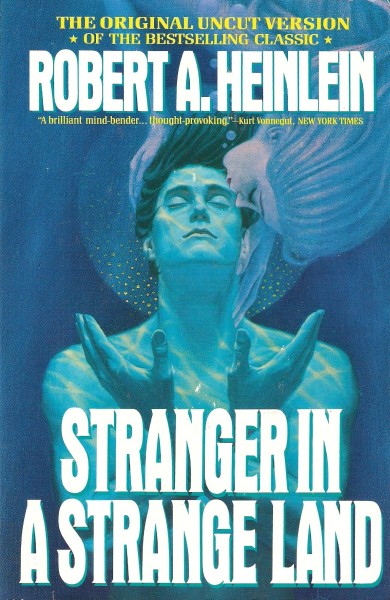
9. Stranger in a Strange Land, by Robert A. Heinlein

Everything about this book, from the delightfully happy grasses that are supposed to be stepped on, to the cannibalism...

Everything in this book is wonderful.

When you have to invent a word for your story to be told, a word that means at once to understand, to accept, to learn and to love, that's a story that might be worth sharing.

Or banning, if that's your thing, I guess.


10. Don Quixote, by Miguel de Cervantes

I can't for the life of me imagine why this book is banned. It's hilarious, and poignant, and sweet, and romantic. Especially romantic.

And funny. Did anybody ever tell you how funny Don Quixote is? Because it is.

I read this book while M was going through chemo and radiation. At the time, I just wanted a big heavy book to read, I figured I'd be sitting in a lot of waiting rooms so I should have something that would DEFINITELY keep me occupied. It wasn't until much later I realized how incredibly appropriate the choice was.

It's one of my all time favorites now. I keep an illustration of Don Quixote framed in my living room.

My kids and I read banned books right underneath it.


You remember that facebook meme going around a few weeks ago? People listing ten of the books that stayed with them through the years?

How about everyone shares their favorite banned book this week, instead?

September 18, 2014

Too Soon

1974
I don't generally go around bragging about my dad. I'm more of a go-to complainer. He can be unreliable in his travel planning, he can be a little myopic and insensitive, and he sets impossible standards when it comes to singing my kids to sleep. Or rather, singing for hours and hours without once pointing out that they SHOULD be going to sleep.

The truth is, he's a pretty remarkable guy.

He's also sort of kind of famous. For a while I was considering geekiness as a lifestyle choice- I learned HTML back in the days of AOL and dialup, I began learning a few other assorted (and now totally useless) coding languages, and I contemplated following his footsteps into the technology driven future.

I quickly learned that I would rather be covered in paint and children, and redirected my energy. But I learned a few things about geeks and nerds and the culture in general that put me off.

And the biggest was that my dad was kind of a celebrity. I instituted a rule for all future would-be suitors: If they knew who my dad was and fanboy-ed out about him, I would not, under any circumstances, go out with them.

Later in life, this has proven to be an excellent benchmark. I have a close friend who recently broke up with a total turd of a boyfriend. The sort of boyfriend who empties your bank account, trashes your credit, and then abandons you without any funds or resources 5,000 miles from home.

The day I met him he lost his cool completely, recounting my father's entire biography to me (as though I didn't know it), and informing me that he had edited Poppa's wikipedia page.

What I find most interesting about Poppa's celebrity is that the thing he was always most proud about is the thing I also take the most pride in on his behalf, and has nothing to do with the things that makes him sort of famous.

Poppa is known for his work inventing MIME- that's the standard that allows anything other than text to go over the internet. Fonts, colors, pictures, sounds, you name it- it's MIME.

But when he was fifteen he made history as the first kid to win a cash settlement after suing his high school.

Forty two years ago, my father sued his high school and won because his high school's principle had violated his freedom of speech. He, and many other students, were evicted from their Columbus, Ohio public school for wearing black arm bands on the anniversary of the Kent State massacre.

This was utterly historic. I don't say that as a daughter, I say that as the kid who stumbled onto this story while researching the history of nonviolent protest during the Vietnam War for a school project. He wasn't mentioned by name, but he was in the history book in the library. He still has the issue of Playboy he was written up in, again, not by name. It mentions that a fifteen year old student had successfully sued his high school. What Playboy added was, "proving that American teenagers still have the right to mourn their dead."

So, of course, when the news popped up of Urban Outfitters "vintage" Kent State sweatshirt... I couldn't help thinking about my dad.


Here's the thing about poking fun at the dead. It's all well and good until it hurts the living.

It's easy enough to forget that there were real victims at Kent State. It's been more than forty years. The idea of police killing unarmed teenagers is frighteningly mundane these days.

The grief was real then, and it's real now. And PARTICULARLY when the country is being torn apart by police violence, by protests marred by tear gas and bullets, when we forget the name of the unarmed teenager killed last month because we're focusing on this month, and we just don't have enough space in our brains to list the names of all the kids who are never going to go home again, it is unfathomably inappropriate to make jokes about massacred teenagers.

Is this the precedent we want to set? That given a few decades, Michael Brown is going to be a punchline? In twenty years, can we expect lawn signs that say, "Neighborhood Watch : Carry Skittles At Your Own Risk"?

The apology from Urban Outfitters, if you can even call it that, is beyond insufficient.

The fact is that we live in a society that is more and more tolerant of more and more violence. While we begin to have public conversations, REAL conversations about domestic violence and child abuse, we also move on and ignore misogynistic murder sprees (Santa Barbara et. al.) and mass child slaughters (Sandy Hook et. al.).

Let's not pretend this is okay. Let's not compartmentalize our indignation.

Let's be honest about what is and what is not acceptable for a society to embrace.

September 12, 2014

#WhyIStayed, How the Vanity Fair #LiftTOUR is Helping, And How You Can Too


I had this one really bad date, once. Back before M and I got involved.

I'd been out with him once before, and we got into a petty argument about nothing after dinner... which he'd paid for.

I was, as I now understand, a pretty sheltered girl. I'd grown up in a liberal, progressive environment. While I knew sexism and misogyny existed, I'd never really been the subject of either.

He said something about me shutting up, because he'd paid for dinner. And I said something back. Something probably loaded with snark and that may or may not have implied that there was no way in Hell I was having sex with him that night, if ever. Even if I had invited him over to my place for a cup of tea.

And then he grabbed my hair and yanked me halfway across the room.

Like I said, I was sort of a sheltered girl. I was in shock. I was in total disbelief. Who did he think he was? A lifetime of wrestling with my sisters (who fought DIRTY) kicked in on instinct. I elbowed him in the stomach, punched him in the face, turned and kneed him in the crotch, kicked him in the knees and took off running. I locked myself in the bathroom and didn't leave until I was sure he was out of the apartment.

It wasn't until later that night that a song I'd learned back in middle school started running through my head ad nauseum. It was a self defense mantra somebody had put to music- in a cheery rhythm, the vocalist croons, "Eyes, knees, groin, throat!" to remind you where to hit your attacker to cause the most pain in the shortest period of time, so you can get away. Yes, it was a real song.

I was, in retrospect, ridiculously lucky. It was a second date. I wasn't involved with him. I could walk away.

Most women who discover they're dating abusers aren't so lucky.

Reading the #WhyIStayed feed on Twitter has been harrowing, but in many ways more uplifting than I could have imagined.

Here are women, spurred into a kind of action by the Ray Rice video, coming forward and talking honestly about domestic violence.

There are a few things you need to take away from #WhyIStayed.

The first is that women in abusive relationships aren't just victims of physical violence. They're victims of emotional manipulation as well. Most abusers threaten self harm, either explicitly or otherwise. Their victims feel guilty for not helping them.

The second is that leaving is often the most dangerous thing a woman in that situation can do. A woman is most likely to be murdered by a boyfriend or husband, and then most likely to be murdered if she's in the process of leaving.

We've normalized it. "If I can't have you, no one will!" We've practically romanticized it. And it's terrifying.

Many women, when they fight through the guilt and fear, face other challenges to leaving. They don't have control of their finances, which means they will run away from shelter and food into homelessness. Many have children, who they risk losing to the custody of their abuser.

These are real concerns.

When Janay Palmer says she doesn't want to press charges against her husband, this isn't just Stockholm Syndrome. This is self preservation.

She now has an abusive husband at home, without a job. Things are no doubt about to be much more dangerous for her. And while she may stay with a man who hits her, who abuses her in inexcusable and unforgivable ways, we cannot judge her. This is a man who has the money to post bail if she did press charges, who could kill her or take her kids. Those are real concerns she must negotiate as she decides how to extricate herself from a situation that she knows better than anyone else.

Leaving is hard, and yet, it is achievable. But only with help. With tremendous, collective help. It takes the help not just of a good friend and supportive neighbors, it takes a massive community to help women get on their feet and start a new life.


This week, I was fortunate to get an opportunity to attend a Vanity Fair event, to benefit Dress for Success. I was planning on going anyway- I was going to write all about breasts and taking care of them- after all my sex positive posts, it was a no-brainer for me to talk about body positivity and bra fittings. The fact that Vanity Fair was donating bras to Dress for Success was icing on the cake.

But then the Ray Rice video broke. I didn't watch it. I'm not going to watch it. And although it was on my mind, I didn't dwell on that one horrible turn a long-ago second date took. Instead, I started thinking about the day, six years ago, I spent volunteering at a Dress for Success showroom. I helped sort clothes. Anything too old, anything stained, anything that didn't look brand new and fashionable and professional went on to be donated elsewhere. The showroom gleamed. And everything inside was free.

I talked to one of the women helping us volunteers keep things organized. She told me she'd been in an abusive marriage for eight years, and it was seeing her children get hurt that made her leave. She told me about the homeless women who come in, the women fresh out of jail and living in shelters, who are treated with respect and dignity, as customers and not as charity cases.

That woman's voice was in my ear all week.


Dress for Success is part of the massive network out there to help women get out of abusive relationships. It's a non-profit that provides women with professional clothing to wear, not just on a job interview, but to work. To get them on their feet. More than clothes, Dress for Success provides career development tools as well.

And Vanity Fair is partnering with Dress for Success to donate brand new bras.

As often as people donate new and gently used clothing to organizations like Dress for Success, underwear is rarely part of the gift. And a properly fitting bra can do wonders not just to make you feel comfortable and supported, but to help you feel in control of your body, and your life.

I say this as somebody who has a nearly impossible time finding bras that fit. (Seriously, YOU try finding yourself a comfortable 34 or 36 J. Yeah, I said J. On top of being freakishly huge, they also grow out of my neck. That is not a joke. My chiropractor should be paying for my bra purchases, these boobs probably pay her mortgage.) Truly, a good bra is like magical armor.

The Vanity Fair LiftTOUR is going across the country through the end of October, fitting women for bras (for free), and giving them the opportunity to donate a brand new bra to a woman in need. When you donate a bra, you have a chance to write a note of encouragement, tie it to the bra with a ribbon, and be certain that whatever woman becomes its owner feels empowered and encouraged.


I'm honored to have had the chance to help Vanity Fair and Dress for Success reach out to women in need.

Join up with Vanity Fair and Dress for Success when the LiftTOUR comes near you. Help women in need become empowered and independent.

There's more you can do that reading an endless stream of #WhyIStayed tweets, feeling overwhelmed and helpless. You can partner with organizations working with women to put an end to their domestic violence.

Those two things I wanted you to take away from the stories of survivors- remember them. Remember that victims must choose the time to leave carefully, and that when the time comes they need mountains of help. They need villages upon villages.

You can be part of that.

Thank you.

September 10, 2014

What It's Like To Be Suicidal #WorldSuicidePreventionDay #NationalSuicidePreventionWeek


There's a common myth that suicide is a coward's option. The "easy way out." That it's a selfish act, and that people who commit suicide are thoughtless and self absorbed.

The truth, as always, is much more complicated.

Because it's World Suicide Prevention Day, in the middle of National Suicide Prevention Week, let me tell you what it's like to be suicidal.

Life is more than hard, life is impossible. Your body hurts, and you neither know nor believe you'll ever know why. Your brain is foggy, and thick, and there's a haze in thinking that makes simple, mundane tasks feel impossible.

You see everything through a fog of self loathing, and you believe everyone else must see them that way too. You expect your friends to abandon you, because you are worthless and depressing and sap the joy out of life. As you alienate them, the grief that they must find you awful only fuels your depression.

You see yourself in only the worst possible terms, and when you're given a glimpse of your life through the lens of happiness or success, it brings all your misery into sharper relief. There are few things more painful than joy, when it becomes clear that you understand that which makes life living, and are simply denied the ability to experience it.

You believe you are a burden. Your constant sadness, your inability to complete tasks, your chronic complaining or resigned silences, the endless droop of your eyelids and the way you have to pause before smiling- to remember that it's an appropriate human response, you believe all of these things make you bad for other people. You believe your depression is infectious, and that your presence endangers people around you.

You believe that if you were dead, people would get over it. They would move on. Your parents, your friends, your spouse, your children... they would move on and have their own lives. Lives that would be richer without the constant strain of dealing with you.

You are scared of pain, and you are scared of death, but only a little. Your fear is absolutely nothing in comparison with the constant agony of living. The constant doubt and hatred and sadness. You begin to wonder what ways you could overcome your fear of death and take your life the most quickly, cause the least additional burden to your loved ones.

Men and boys, they tend to go for the sure-fire, foolproof death. Gunshots, hangings, jumping off bridges and cliffs.

Women, they generally go for the cleaner methods. Leave a corpse that just looks like a corpse, and spare their loved ones the trauma of cleaning up the bits, even if the death itself takes longer. They gas themselves in ovens or parked cars, overdose on medication, swallow bleach.

You spend weeks, months, years, debating what method to choose. You spend weeks, months, years, slowly building a plan- not because you're going to do it, but because it's a comfort. It's a comfort to know that when you truly can't bear life anymore, you know how to get out. The comfort becomes an addiction, and then an obsession.

You begin to give things away. To let your friends and family know that you love them, that they should never question that. That you love them more than you love yourself. You have no doubt this is true.

And then, finally, you snap. Frequently, it's joy that does it. It's a good day, a good party, a good dinner. Something really, truly good. And you think to yourself, "This is the last time I'm going to feel happy, ever again."

And you calmly begin to carry out your plan.

That is what it feels like to be suicidal.

I want to be perfectly clear- ALL of this. The feelings, the self loathing, the belief that you are bad and the world is bad and it will never be okay. the idea that you are hurting people you love simply by being alive, all of that...

All of that is a lie. It is all a lie that depression tells you, that a disease spreads through you. It is an illness, and it can be treated. It is not true.

Depression is an insidious disease. It masquerades as your own thoughts and emotions, but it's not. It's a tumor, sending out little metastasizing molecules and infecting your entire thought process. It's a self-detonating time bomb.

It is not your fault. Nobody goes out out looking for depression, but it finds you. It comes through windows in your experience. PTSD, RTS, panic disorders, chronic illnesses, a bad day. Depression is a disease that like to tag along with the other crap events that happen in life, and when it sets in, you tell yourself it's okay. You're not depressed, something happened and it's bumming you out, but you'll get over it.

Usually, you do.

Depression is like a germ. You can wash your hands and keep Purel on your desk, but sometimes, it will get inside. And you're not defective, you're sick. And there's help.

There is always help.

People with depression often don't go looking for help. They're too consumed with guilt and self loathing. When you hate yourself, you don't want to help yourself. And when you're ashamed of yourself, you want to punish yourself. The disease causes the symptoms, the symptoms perpetuate the disease.

Often the first cry for help is an experimental suicide attempt.

If somebody you know, seems depressed, there are things you can do. Ask them how they are. Let them know you care about them. You don't have to tell them you think they're depressed, just make an effort to talk. To keep the lines of communication open. Invite them out, and offer to spend an evening in. Be honest with them. If it becomes clear that yes, they are depressed, let them know you understand and you're willing to help.

If you are depressed, talk to your doctor. Talk to a therapist. Talk to a friend. If you find yourself fantasizing about suicide, call the National Suicide Hotline- 1.800.273.8255. It's open twenty four hours a day, every single day.

Know that yes, life moves on for other people. But it also moves on for you. You can survive, you can get better.

Like any chronic disease, there are flare ups. And these can be more dangerous than the original occurrence. Just like cancer, knowing you've beaten it once doesn't mean you can't beat it again, and there is no shame in its return. Just as you wouldn't blame a cancer survivor for a new tumor, don't blame yourself for your depression. It is beyond your control that your depression returned.

But you can get help again, and you can get better again.

Be well, everyone.

Be safe.


August 25, 2014

My Body, My Choices- Thoughts on the Chicago SlutWalk


Over breakfast on Saturday morning, I reminded the children that we were going to a rally. To protest, as I simplified for the children, when people are mean and hurt other people, then say it's the other person's fault because of what they were wearing. I told them, as I often told them, "You're in charge of your body, and nobody is allowed to touch your body without your permission."

"There will be lots of people with signs there. I think most people will have signs. Would you like to carry signs, too?"

"Yes!"

"What would you like them to say?"

DD answered in typical DD fashion: "You should wear whatever you want to wear because you get to wear what you want and people shouldn't be mean to you because of what you wear and you get to wear what you want and if people are mean that's not okay because they don't get to choose what you wear and you do get to choose what you wear and they don't get to be mean to you."

"That's an awful lot to put on a sign. How about, Wear What You Want To Wear?"

"Yes! Can it be pink?"

"Yup! SI, what do you want your sign to say?"

"How about, I'm in charge of my body?"

And so I made the kids signs, and RH freaked out. "I want a sign! I want a sign!"

As we were on our way out the door, I grabbed a sharpie and whipped up a quick little sign for her, without asking first. Considering that RH is the most stubborn kid I've ever known, I thought a message she's approve of was that she makes the decisions regarding her body. This is already as true as it can be for a two year old. "What's it say, mommy?"

"My body, my choices."

"MY BODY! MY CHOYZIZ!"

"Good enough."

Forty minutes later, we were at the fourth annual Chicago SlutWalk.

Of course the kids were a hit. Everybody who stopped and asked what their signs said got an earful. SI especially loved telling people EXACTLY what her sign said, and what that meant. She got a lot of high five from essentially topless women.

I was so proud of them. I was so proud of them for asking intelligent questions all afternoon, and being patient through over a mile of marching. I was so proud of them for being polite and kind to the people there.


I took a picture of them with their signs, and when we got home, I put it on the Becoming SuperMommy facebook page and twitter.

Within hours, the backlash came.

Let me be clear- I have taken my children to SlutWalk twice before. I have published pictures of my children at SlutWalk twice before.

Never have I experienced anything like this.


Maybe it's because all the responses I've had to previous year's SlutWalk posts have been so positive, I was blindsided. And more than that, I was hurt.

Because, knowing full well that one should NEVER EVER EVER EVER EVER engage with a troll... I responded to them.

And what they said pained me in my soul. Not because of the personal nature of the attacks, that didn't bother me at all. It was their profound blindness to reality.


What got to me was knowing that in attempting to help my children escape and change a culture that devalues them for being female, that will condemn them for what they wear and blame them for their own victimhood, I have exposed them to a form of that violence.

I knew it was possible that as we marched people would shout unkind things. I was ready to talk to them about it. To teach them.

What I wasn't ready for was being personally attacked for teaching them. And I realize now how profoundly naive that was.

The fact is that we live in a culture where events like the SlutWalk are still necessary, because we live in a culture where college students are devoting their time to inventing nail polish that detects date rape drugs. We live in a culture where thousands of people think it's a good business idea to produce rape-proof jogging shorts.

And there IS a need, and a market for those things, because sexual violence is RAMPANT.

When they go to college, I don't want to have to take my daughters shopping for anti-rape pants and nail polish that changes colors when exposed to roofies. I don't want my children going to high school and being able to relate to a new generation of teen political anthems, like this punch-to-the-gut country song:


Yes. There's a country song about Steubenville-esque high school date rape. Because this story is so damn common that it's horrifically relatable.

THIS is the world we live in.

This is the place I have to teach my daughters to navigate. To survive and thrive in.

This is the world I have dedicated myself to changing so that the burden my daughters bear will be lighter.

I took my children to a place where women were dressed provocatively, some wearing only thongs and pasties. Because the point is that IT DOESN'T MATTER. It doesn't matter what a person wears- they are STILL a person. They are STILL in charge of what happens to their body.

It doesn't matter if they expose their body, that's not an invitation to ignore their autonomy. It's not an excuse to dismiss their ability to say 'no.' It's not public property, even when it's visible.

After the hate mail started coming, I asked M if he was glad we took the children.


"Of course I am," he said. "While I was walking, and reading all the signs and everything, it really hit home for me in a way it never had before. How one out of three women... and we have three daughters..."

I will not apologize for taking my daughters to SlutWalk.

If I had sons, I would be even more determined to take them. Because it is our sons more than our daughters who constantly hear messages that women exist for their pleasure. While I've had many fears about raising girls in my years of motherhood, until Saturday I hadn't really understood what it must be like to fear raising boys. To fear the mechanism of our society that wants to taint them, to train them, to pat them on the head and permit them to become abusers.

I would take my sons to the SlutWalk, and say to them- "These are people. All of these people are PEOPLE. And when you see somebody in next to nothing, or naked, they do not stop being people. They don't suddenly lose their right to control what happens to them. Remember that for the rest of your life."


I will not apologize for teaching my daughters that they control their bodies, and their fates.

But I will apologize for this world, because I am a part of it. And until I can be confident that I have more than done my part to make it safe for them to exist here, as girls and then women, the guilt that has plagued me most of my life will continue.

I am responsible for them. For now. For a short window in time, I am in charge of keeping them safe- and more importantly, teaching them to remain safe.

I'm going to keep doing it the best way I know.

At SlutWalk '14


At SlutWalk '12


At SlutWalk '11


August 7, 2014

Reinventing Your Fate - #Change #FindTheWords


As the school year begins, too many children are already falling behind. I am 1 of 30 bloggers helping #FindtheWords with @SavetheChildren to raise awareness of the need for early childhood education for all kids. I am participating in this social media campaign to highlight 30 words in 30 days -- to symbolize the 30 million fewer words that children from low-income homes hear by age 3.

Save the Children provides kids in need with access to books, essential learning support and a literacy-rich environment, setting them up for success in school and a brighter future. Learn more about Save the Children’s work in the US and around the world: http://www.savethechildren.org/site/c.8rKLIXMGIpI4E/b.6153159/k.C8D5/USA.htm


Read to the end for a Giveaway!

When I was about nine years old, I fell in love with the All-Of-A-Kind Family books.

I don't know how exactly they came into my hands, but they were the perfect blend of familiarity and fantasy. A pre-WWI family with five daughters living in New York, Jewish and American, wearing beautiful dresses but also destroying them as they climbed trees and hid in Papa's rag shop.

As a Jewish American girl with two sisters, living in New Jersey, I was in love. I fantasized about my parents having a gaggle of additional children- the idea of being the second oldest took root, and I thought it would be MUCH better than simply being in the middle. The stories the family in the book told about Elijah the prophet and the obviously archaic but still fascinating way girls weren't permitted to study Hebrew, which I began to take particular joy in doing at synagogue on Saturdays, stayed with me as I stayed up all night, reading and re-reading the stories.

And then I had the most incredible discovery- there were more All-Of-A-Kind Family books.

I snuggled under the covers to read the second, All-Of-A-Kind Family Downtown, and read with total obsession the story of the birth of the five sisters' new baby brother.

He was sick, and it seemed he might die. So one day, in the midst of all the worry, Papa takes the baby to the rabbi, to change his name. Papa explains that sometimes, when somebody is very sick, the only thing left to do is change their name. That way, when the angel of death comes looking for them, they'll be looking for the wrong person and pass them by.

Silly, I know. The idea that you can change your name and be so profoundly changed that your own fate can't find you. But it resonated with me.

It was around that time I had become not only an insomniac, but also depressed. As my childish depression deepened into something more profound, I kept thinking about that story. About changing your name and changing your destiny. And so when I was ten years old, I made the decision to change my name.

My grandmother mocked me. She would call me "Rachel," and I would answer, and she would point out that if I didn't want people to call me that I had to stop answering to it. So I did. From that point on, the only name I would answer to was my middle name.

I was determined to stop being Rachel. I was going to be somebody else. Somebody less frightened of being made fun of, somebody bolder and braver and more confident. To me, 'Rachel' was a shroud I'd been wearing my whole life, and had done nothing to make me happy. So I shrugged her off, and assumed the identity of my middle name, 'Lea,' who wore whatever the hell she wanted to instead of trying to fit in with the WASPy pre-teens in her girl scout troop. Claudia, from the Babysitter's Club, became my style icon. I cut off my long hair and embraced the "New Jan Brady" style 'fro that puffed up in its wake. And then my family moved.

I embraced every aspect of this change. I was a new person, with a new look, a new outlook on life, and now- a new location. I showed up for my first day of middle school with my hair puffed in a halo around my head, horn rim styled pastel glasses, a floor length gold skirt, and a blue cropped faux turtleneck t-shirt.

And while it was true that everything on the outside had changed- my appearance, my name, my location, my school... things were fundamentally the same. I was still woefully unpopular, still the butt of ceaseless jokes and the recipient of incessant bullying, and still profoundly unhappy.

But I was more confident in who I was. I was a person who had defined myself, and although my attempt to change my life by changing myself hadn't exactly worked the wanted it to, it had worked in some way. I had, mysteriously, kind of grown up a little.

I was changed by the act of changing.


----

Books had a profound impact on me during my childhood, but not every child is so lucky. Having books in the house helps children learn not just to read, but to appreciate and cultivate language. 65% of young children in need have no access to books, and more than two thirds of poverty level households have no books appropriate for children in the house.

By the age of three, children from low-income homes hear on average 30 million fewer words than their peers, which puts them at a disadvantage when they start school- a cognitive delay of eighteen months.

But we can change that.

Join in the #FindTheWords campaign! If you see a picture of my word, "Change," tweet it with the hashtags #FindTheWords and #Change. Help raise awareness of what Save The Children is doing to help kids reach their potential, and move out of poverty.

...if all the student in low-income countries learned basic reading skills, 171 million people could be raised out of poverty.


You can help.

And to thank you, I'll be able to give one of you a $100 gift card, from Save The Children. All you have to do is comment on this post, telling me about when reading has changed you. Or helped you change the world for the better. (Please leave your email address in the comment, a link to somewhere I can find you via social media. Facebook, twitter, the usual.)

#FindTheWords. Be the #Change you wish to see in the world.

May 28, 2014

Eight More

Getty Images
I am bone tired.

Not just because my husband and I enjoyed a crazy, whirlwind weekend- our first ever away from the kids.

Not just because we missed our flight home and stayed up all night, flying standby and finally coming back to our home in time for our children to rise and begin their day. Not just because today is a day to them like any other, and they don't understand or care that I'm sleep deprived and suffering the repercussions of twelve hours of airport food and wharf fudge.

I am bone tired because I made a conscious choice while I was on vacation- my first vacation since my honeymoon.

I decided to ignore the news.

This was particularly difficult, as I was vacationing in beautiful Santa Barbara, California. Where this weekend's tragedy occurred.

I say "this weekend's tragedy" to clarify, because I am so damn tired I'm afraid I might confuse myself. Because roughly twice a month for what feels like as long as I can remember, there's been something else like it. Some other person who took their guns to town, despite Johnny Cash's old advice, and slaughtered human beings.

I also say "this weekend's tragedy" because if I were only to say, "A confused, angry man decided to take his rage out on women he saw as having wronged him, and took lives in his fury," I could be talking about the three women who are murdered by their husbands or boyfriends or exes every single day.

So "this weekend's tragedy" it is.

Seven people killed. A gigantic tome of a manifesto by the murderer, who took his own life. A dozen more injured.

Why? Because he believed those women owed him something. Sex, attention, affection, something. He believed those women wronged him just by not seeing in him what he saw in himself- that he deserved them. That he had somehow already won them. That they were not people, but the objects of his desire, and as such he already owned them.

That's what he saw. And so instead of seeking therapy, instead of moving to a country where women legally aren't people with their own rights and own stories and own lives to run as they choose, he targeted and killed them.

He put videos on the internet of himself ranting, blaming his victims for imagined crimes against his fragile ego. It's the same rant you can find in court testimonies in domestic violence cases across the country. It's the same narrative you see in movie after movie, in book after book. "I was there for her, she owed me. She lied to me when she smiled and didn't put out. She led me on. She deserved what she got."

And I am exhausted.

I'm exhausted because #YesAllWomen is trending on twitter, it's trending everywhere, and I can't look away. I'm not on vacation anymore. I can't look at my husband and say, "It's our second honeymoon- it's a special trip- I'm not thinking of sadness or rage or any of it. Let's get in the hot tub and drink margaritas while the sun sets over the ocean." I can't do that, because I can't take my eyes away.

I'm tired of saying over and over again "I'm a feminist" and having people react as though I walked into bar mitzvah with a "Jews for Jesus" t-shirt. I'm tired of saying over and over again that I advocate for victims of sexual assault, but it's not because I'm a survivor. Or not only because.

I'm tired of having to use phrases like, "I'm married," to get men to leave me alone. I'm tired of having to use phrases like, "I'm a rape survivor" to get airport security to stop leering and digital images of my artificially nude body.

I'm tired of drafting conversations in my head I won't need to have for years, to tell my daughters how much I love them but that they need to protect themselves, because even though it's not their job to avoid being raped they will be blamed if they are raped. Not by me, I'll tell them. But it will happen. And I can't stop it.

I'm tired of knowing that I alone can't stop it.

I'm tired of signs and ads and facebook memes reminding people that every woman is somebody's daughter, or wife, or mother, or sister... as though she's not her own person regardless.

I'm tired of sitting in front of my computer, watching picture after picture of victim and villain appear on my screen, and feel the need to make excuses for everyone. To apologize for everyone. To apologize to everyone.

I'm tired of feeling responsible, responsible for my own victimization, and responsible for the fact that it continues.

I'm tired of tragedies. But when they come so fast and so often, it's hard to remember they're tragedies. It's hard not to simply see them as life. As life in a country where women are technically given equal rights, even if our lawmakers refuse to extend them to pay, workplace protections, or healthcare. It's easy to say, "Oh dear, another mass shooting, another murder spree, another bunch of anonymous victims- dead and gone. Somebody should do something to make it stop. Too bad there's nothing to be done."

There's always something to be done.

I'm sorry. I'm sorry I buried my head in the sand and allowed myself the luxury of a weekend. I'm sorry I intentionally closed my eyes and ears to the news happening literally all around me, and drank icy beverages and wandered the beach and gazed at the mountains. I'm sorry.

And I'm pissed as hell that I have to be sorry for that. Because I deserve a few days of happiness and relaxation, don't I?

And I'm miserable at feeling so selfish and self entitled that I could actually dismiss the tragedy of eight families, shrug them off and tell myself I'd feel their pain later.

That's what we all do, all the time. We all say we're too busy. We've got important things to do that don't involve mourning.

Mourning is never on the agenda.

So I'm tired. And I know you're tired, too.

But that's just too bad. Because there is no such thing as being too tired for empathy.

There is only the selfishness in all of us that doesn't want to feel it, because we have more important things to feel.

There is nothing more important to feel than empathy. And I'm ashamed of myself for forgetting that, even for a weekend.

I'm so sorry.

And I'm tired of it.

March 26, 2014

Becoming A Hero


I don't like the phrase, "Things happen for a reason." Enough terrible things have happened to me and my family in my short time on Earth to resent the idea.

I much prefer, "Things happen." Because they do. Things happen constantly, and yes, some people experience worse than others. And you can't exactly choose how you respond to these things. You can't control experiencing fear, or sorrow, or anger, but you can conquer it once it's already there.

And once you've done that, you can decide what you want to do with the experiences you've had.

That's why I joined the RAINN Speaker's Bureau.

I've talked about it before on this blog, a couple of times. But let me tell you, that is a far cry from what it's actually like to stand in front of a room full of people and actually tell your story. Not just any story, the events leading up to and including the worst you've ever known.

But it's not just sharing the story. It's giving it a broader context. Using it as a tool to teach.

A few weeks ago, I was invited to speak at a high school, for 120 high school juniors and seniors. Their teacher is a remarkable educator. He invented an advanced health class that teaches students about health and sexuality, with all the uncomfortable conversations that entails. Students are only allowed in by teacher referral, and only upperclassmen in good standing.

Each year for the last eleven, the students in this class do a mock date rape trial. Students are given roles, from medical examiner to judge to defendant. This class is one of those formative experiences. One of his former students went on to go into law, crediting this experience solely as her motivation.

For the first time in the eleven years this class has existed, all four sections' mock trial juries came back with a "not guilty" verdict.

And for the first time, the teacher reached out to the RAINN Speaker's Bureau to have a survivor, of events nearly exactly like the story he constructed for his students, come to speak to his class. For forty five minutes. For four separate groups of students.

And that person was me.

There's something you experience every time you talk about sexual assault. It's a certainty that somebody is going to call you a liar. To deny your story, to tell you that if events happened as you described, you are still to blame.

Walking into a room of teenagers who found a date-rapist not guilty is that experience under a magnifying glass. Already, this group of teenagers- a notoriously judgmental and self assured group- has decided that the assailant, in a case nearly identical to yours, was not at fault.

What can you possibly say to explain the truth?

The day before the presentation, I lost my voice. Completely lost it. I spent a whole day chugging hot tea, avoiding raising my voice, and swallowing spoonfuls of honey. But when I showed up I was still hoarse and quiet.


As I stood and started to speak, the students stilled themselves to perfect silence. It might have been the only way to hear me. And while I spoke, my hands shook.

But with every word, as they stared and listened, my voice got a little stronger. After twenty minutes, my hands had stopped shaking.

I didn't just tell my story. I told the kids they had been right to choose a not guilty verdict. That rapists nearly always get off scot free, that victims are usually blamed and hushed and ignored or made to disappear. And I told them about the notorious Reddit thread where rapists confessed, and provided us with a rare glimpse into what really goes on in the mind of someone who commits sexual assault.

And I talked about rape culture- I explained that the ideas they had about a girl "asking for it" because she was drinking were wrong. I explained that everything about the way our culture addresses sex and sexual assault comes from the fundamental idea that it's a woman's job to avoid being raped, as though rapists are phantoms, or weather patterns.

I talked about consent, what it is and what it isn't.

The kids asked questions, and I was shocked and impressed by the depth and candor of their questions. I was amazed by their insight. And I answered them as honestly and candidly as I could, no matter how painful.

I spoke for three hours, and it got a little easier as it went on. After each class a few students came by to ask more questions, privately, to say thank you, or to engage in a quick conversation about rape culture.

And I was floored.

By the time I got home my voice was worse than gone, and I felt exhausted in a bone deep, emotional way.

But I felt like maybe, just maybe, I had really done something that made a difference.

I told those kids that what had been missing from their trial, and from all rape trials like it, was somebody who could stand up in court and say, "He knew, without a doubt, the victim didn't consent." I told them that now everyone in that class had the ability to be that person, because everyone in that class could explain to their friends, their siblings, their parents what is and what isn't consent. So everyone in that class had the power within themselves to prevent sexual assaults from happening, by preventing rapists from becoming rapists.

I think it hit home for many of them. I hope it did.

And as for me? I feel empowered. And perversely enough, I feel fortunate. This is something I could do for the rest of my life. With my life.

Things happen. And I'm glad I've found a way to give them meaning.

March 20, 2014

World Water Day #WorldWaterDay #waterstory


I've never gone without water.

I've contemplated it. When you grow up in the great lakes region, talks of climate change matter. They have immediate, real world consequences.

I remember the day I learned about global warming. It was my freshman year in high school, and our teacher did a segment based on a series of studies about the rising global temperature. Being a experimental, holistic learning school, we did more than study the science. We also used the science as a basis for sociological, historical, and literary learning. In Western Civilization, we talked about the history of human beings going to war over access to resources- including fresh water.

"In fifty years," my high school science teacher told me, "it's likely that half the world could be at war over water."

Because rising coastlines don't just drive people inland, they also contaminate fresh water sources with salt water. And de-salination is costly and difficult.

But we lived in Michigan, surrounded on nearly all sides by fresh water. Lake Superior, all by itself, has enough fresh water in it to cover North and South America in a solid foot. Which meant that if you were looking for a good long term investment, real estate in northern Michigan was a decent plan.

I sat on the deck of my parent's house, dipping my toes in the spring fed, potable pond where I swam all summer without having to think twice, thinking about people fighting every day for water.

I looked at the lush, green trees. I thought about the ducks and herons and frogs and turtles and fish and even snakes that shared my lake, and thought about the charts we made in Creative Problem Solving, of what parts of our ecosystem would be destroyed by a raising temperature.

I thought about all the fluorocarbons from the sixties and seventies, still eating up our ozone.

And I sponsored a child in Ethiopia with the last of my bat mitzvah money.

I did it to alleviate my own guilt- because it seemed so unfair that people were already living with drought, and famine, and they couldn't even get water. Water. And I was completely surrounded by the stuff.

In the last fifteen years, not a lot has changed. Those same flurocarbons are still up there, we're still making more, and the global temperature is still rising.

And there are still people all over the world without access to safe, potable water. 768 million of them. A tenth of the world population.

2,000 children die every day from drinking tainted water, the only water available to them.

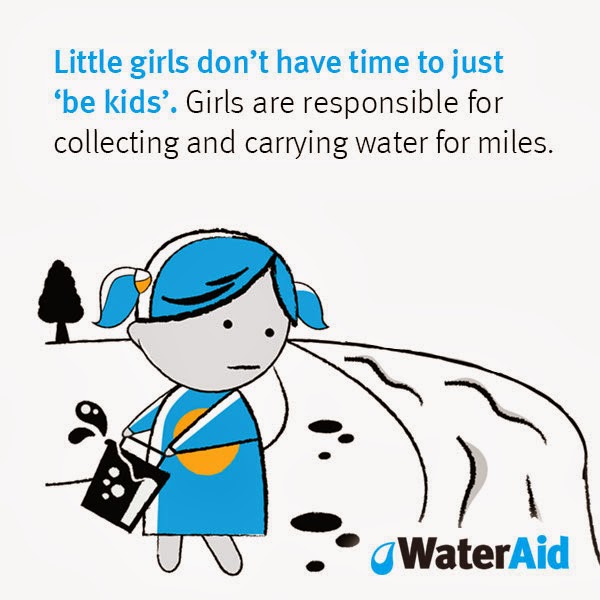
And, as with nearly every problem in the developing world, it's even worse for women and girls. The lack of access to water also means fewer toilets. In fact, in many regions of the world where water is scarce, schools have no gender segregated bathrooms, and this causes girls to leave school as soon as they start menstruating.

And it falls on girls to provide water for their families. Each day, women in developing countries without adequate wells walk an average of four miles to carry water to their families. Instead of getting educations, they're carrying water.

Only one in three people on our planet has access to a toilet. To a toilet. And lack of access means that women in places like India have to travel through incredibly dangerous areas to find a toilet. Women risk sexual assault just to find a place to relieve their bowels.

So what can you do, right? What can you do to help?

First of all, you can donate. Just $25 is all it takes to provide a person with access to water and sanitation. That's all it takes.

And you can help raise awareness. You can call your congressmen and tell them to support the Water for the World Act. And on Saturday, World Water Day, WaterAid is hosting a social media to raise awareness. On Saturday, take a selfie with a glass of water, and use the hashtag #cheerstoH2O. Share your stories of a time, any time, when you didn't have access to water. When you knew how it felt even just a little to be without.

With awareness, we can start to bring about change. So let's all start there.

LinkWithin

Related Posts Plugin for WordPress, Blogger...

Vote for me!

Visit Top Mommy Blogs To Vote For Me!