Showing posts with label Christianity. Show all posts

December 3, 2014

Drowning in the Creep

M and the kids tracking each others footprints in the snow on Thanksgiving
I love Thanksgiving. I've always loved Thanksgiving.

For Thanksgivukkuh last year, I bought my kids a wonderful book- "Rivka's First Thanksgiving." In the book, a little girl in Brooklyn learns about Thanksgiving, and convinces her orthodox Lubovitch community to celebrate the holiday.

Because as first generation immigrants to America, the story of being welcomed in and protected by a new community spoke to her.

And being immigrants fleeing religious persecution in Europe, the story spoke to her more still.

In many ways, Thanksgiving is like American Passover. You gather with your family to recreate a meal, a meal where peoples of different backgrounds came together to celebrate that they would survive. Squanto was like Moses to the Pilgrims, and Moses would have been a stranger to the Jewish slaves.

It's a lot like Passover, really. Almost uncannily. Except instead of an afikomen, you get pie for dessert.

I love Thanksgiving.

On Amazon!
Which is one reason I can't stand Christmas Creep.

For many people, Christmas is the only thing they seem to like about Thanksgiving. For many people, Thanksgiving is wonderful because it gives them permission to stop holding back in their Christmas zeal, and the minute the table is cleared after dinner it's time to ring those sleigh bells and move onward towards the real winter holiday.

Only the thing is, unlike Thanksgiving, not all Americans recognize Christmas.

Thanksgiving is wonderful to me in that it is so comprehensively American. From Turkey tamales to three sisters stew, from pumpkin crumble to persimmon pie, every corner of America is filled with people celebrating what might be a largely fictional story, but is a fundamentally hopeful one.

Christmas? Not so much.

For me, as for most non-Christian Americans, Christmas is an annual giant, exclusive party that seems to grow by a day or so every year.

And I had no idea how much more lonely it would be for me once I had interfaith children.

As you probably know, M borders on agnostic and I dabble with atheism. But we appreciate the traditions and familiarity of our respective faiths.

The historically Jewish city of Chefchaouen in Morocco-
where the Jews who built it so strongly identified with their heritage that they painted the city blue.
We always planned on celebrating Christmas and Channukah with our kids, and we've celebrated both holidays with them since the first. But the fact of the matter is, to be Jewish is to be excluded. Not just here, in the United States. Everywhere.

We, as Jews, exclude ourselves.

And in a way, I think that is what has allowed us to survive this long. As isolated strangers in non-Jewish communities, we have always excluded ourselves. Like Tevya says of the Cossacks in Anatevka, "We don't bother them, and so far, they don't bother us." Until of course, the Czar decided some bothering was due.

We carved our niches out of the communities we wandered into, and although we lived side by side, we lived separately.

Not so, in 20th and 21st century America. We managed to make ourselves seen, and heard, and somehow welcomed for the most part. We accepted the mantle of "whiteness" the civil rights movement offered us. We started seeing ourselves as Americans as well as Jews. Something we certainly never did in Russia or Morocco.

The blue streets of Chefchaouen
But part of the appeal of the United States, for all immigrants, has been that it is a country without a single faith. That it is a country without a unifying culture. That it was and has always been based on ideals of freedom from religious persecution.

And the fact is, to be so thoroughly surrounded by a single holiday that you do not celebrate is smothering. To be vilified as being a "Scrooge" or a "Humbug" for feeling no love for a holiday that means nothing to you is a form of duress. It is a culture that says, "Pretend you believe this, or you are not one of us."

For most of my life, that feeling of isolation and rejection for not trimming trees or writing letters to Santa was something that felt natural to me. That felt like as much a part of my heritage as the bland, mindless way the Shabbat bruchot came to my lips as a child waiting for Friday night dinner.

It is not the same now. Now, I have children. Children who love Christmas, and whose love of Christmas hurts me.

I feel petty and unkind and shallow saying so, but it's true. That I am and must be complicit in their affection for Christmas only makes it worse.

I have little love for Jesus, in whose name countless atrocities have been committed against my ancestors. In whose name, as a child, my best friend sobbed and begged me to convert, because she didn't want to go to Heaven if she knew I was going to Hell. I have made my peace with Jesus, for the most part, who I think was probably a man trying to do some good, if he existed, which I can never know.

But I don't understand what American culture has done to his birthday. And in his name.

I don't understand how Santa Claus came to be, or why I must lie to my children, in however sheltered terms, rather than saying what I know is true. But I continue to lie to them. I tell them that he is real to them, because they have somebody who loves them and wants to make him real. The way fairies are real to some people, when somebody loves them and wants to make fairies real to them.

It's a pretty lie. It's one that I had hoped wouldn't hurt me to tell. But it does. Because I cannot make Santa real. I can only drive this wedge further between my children and myself, isolating myself more and more from their understanding of the world and their understanding of mine.

Our friends, Santa and Mrs. Claus with their favorite elf, visiting our children several Christmases ago.
Friends who love our kids enough to make Santa real for them.
For me, and for most Jews, to be Jewish is to be excluded. It is to be separate, to use our own favorite turn of phrase, to be "Chosen."

Part of what we choose is this otherness, and I wonder if my sister wasn't really right when she warned me about having children with a Lutheran.

"Can your children really be Jewish, if they grow up in a house that has a Christmas tree?"

I said I didn't care, but I know now that I do. I care very much. I want them to feel what I feel about my heritage, about my ancestry and my history. Their ancestry and history.

I want them to learn that part of being Jewish is being isolated from the larger community. That as welcome as we may think we are, we are always waiting for the tides to turn. I want them to understand that on Thanksgiving we are all American, and we are proud, and we are humble, and we are unified. But on Passover we remember that in every generation there comes somebody who would try to destroy us. That in every generation there is a genocide, and we have made it to this day by seeing the tides when they turn, and remembering who we are and where we came from.

When, in October, my children squeal with delight at the sight of Christmas lights in a store, I feel more lonely than ever in my life. My children, these people I made who shared my blood and my body, and will always share my history and my life, my children have been anxious for Christmas to come since that first sparkly snowman made his appearance on the Costco floor.

They gush about Christmas. They tell me what they want, they tell me they want to see Santa, they tell me they want to make Christmas cards and have Christmas stockings and a Christmas tree.

As they have had every year.

And I ask them, "What about Channukah? What about lighting the menorah each night? What about singing Channukah songs with me and Poppa?"

For them it's an afterthought. Something nice that will happen as well as Christmas. Not their isolated holiday warmth, not the oasis of familiarity in a Christmas dessert, where costume clad volunteers on the public train stare with fear in their eyes when someone responds to their, "Merry Christmas!" with "Chag samayach to you!"

They learn that fear young. "Did you know?" an eight year old friend asked me, her face pale and numb, as we arranged Barbie shoe filled traps for each other on her bedroom floor, a la Home Alone, by the light of the garlands strung down her bannister. I was too ashamed to speak, now part of the mechanism that had built and shattered what would become a formative childhood experience.

It wasn't that I didn't believe, it's that I knew the truth. And the truth was my parents kindly but sadly explaining that I should not tell other children the truth. That I must distance myself to protect them. That my distance was essential to their happiness.

As a child, I resented Christmas, and I could not escape it. I could not escape singing Christmas songs at my public school. I could not escape the constant talk of what Santa would bring to other children, and not to me. I could not escape the ornaments and tinsel in every grocery store, on the light poles downtown, on the bulletin board outside the Principal's office. I could not escape the trees, covered in candy canes or tiny toys, standing resplendent in all my friends' homes- shrinelike on their velvet skirts, revered in their untouchable beauty. I could not escape the Christmas stories on my television, every beloved character celebrating the very holiday that excluded me, until I couldn't bear any longer to watch even the Muppets imply that I, like Scrooge, was a "humbug."

For me, Channukah became meaningful not because of the story, a military holiday as opposed to a religious one. For me, Channukah was meaningful because after all the loneliness and sadness of my friends slowly distancing themselves from me, I found myself surrounded by the familiar songs and faces and foods of my people. My holiday. My little light in the winter dark.

Now, as always, my friends are beginning to shrink away. Earlier and earlier every year, with facebook quizzes about "Holiday Movies" based on "It's A Wonderful Life" and "Miracle of 34th Street," as though by erasing the word "Christmas" from their enthusiasm I can join in, I can pretend that my own experience includes Santa Claus and Christmas Miracles, as if just by being American I must be part of this, as though despite making myself visible as someone "other," I am at fault for neglecting my cultural duty to watch the Greatest (Christmas) Films Of All Time.

I find myself less patient with my inability to participate. I find myself feeling like a liar more and more, even as I tell my children that Santa is only real if somebody makes him real for you.

"I can't make Santa real for you," I say, and this is also a lie. I am complicit. I am the one who fills the stockings when their backs are turned. I am the one who lies by omission, by saying that Santa is real for anyone, ever, when Santa is a fiction who brings comfort to the majority of our neighbors, but only ever hurt me. Only ever guilted me into prolonging the moment when my friends would be crushed by the destruction of their happy fantasies.

The truth is that I don't want my kids to believe in Santa. Not because I don't think they can't really be Jewish on a fundamental level if they have a Christmas tree in the house. I think that it's hard to really empathize, to really understand who their ancestors were and what they faced if they don't understand what it is to be other. To be excluded and to understand that purposeful exclusion is a threat, but at the same time that self imposed exclusion can be safety.

Jewish men praying under guard in a Polish shtetl in 1940
Last month, the children cheered when they saw a Christmas tree in Costco, and I ignored it, stony faced.

"Is Christmas soon?" they asked, eagerly.

"No, first comes Thanksgiving. And then Channukah," I said.

"So why are there Christmas trees?"

It was a simple question, and I answered it simply.

"Christmas Creep."

"What's Christmas Creep?"

"Christmas Creep is when people are so excited about Christmas, they forget there are other holidays that other people celebrate. Including Thanksgiving, which is next."

"Why do they forget there are other holidays?"

"Because they don't need to remember, sweetie," I said, sighing, pushing my cart into the cold parking lot. Pushing it past other carts laden with trees and lawn reindeer and mountains of tinsel.

They don't need to remember, but I do. Jews do. "Never forget," and all of that.

The truth is that Christmas Creep isn't just about forgetting other holidays, it's about forgetting other people. And worse than that, Christmas Creep is about forgetting Christmas as well.

My husband, the Lutheran, hates Christmas Creep more than I do. For me, it's a familiar angst. For him? It's a reminder of what is constantly being lost for people who DO celebrate that particular holiday.

M tells me that he didn't really learn what Christmas was about until he was in college. An adult. Until he left home, Christmas was about getting. Now, he says, Christmas is about family, and love. Seeing his cousins in Minnesota, who he sees so painfully rarely. Seeing his aunts and uncles and remaining grandparents. Meeting babies and seeing how absurdly much children have grown. Physically being with the people you love.

But it's hard to explain that to a child through the haze of tinsel and and the twinkling of fairy lights.

Just under half of M's family (half of them)- an eight hour drive away
M can't stand the Christmas Creep, not because it makes him feel alienated from the world around him, but because it makes him resent the waves upon waves of distraction from what he actually cares about.

Neither of us are likely to jump onto the Holiday Fever bandwagon before we've thoroughly enjoyed our Thanksgiving weekends. Neither of us are eager to give up time with our families to buy things we don't necessarily need for a holiday we feel, in the case of both Christmas and Channukah, shouldn't be about presents anyway.

Despite this, M loves Christmas. He loves putting on his cheezy Christmas sweater, drinking quarts of eggnog with a grin on his face, hanging a wreath on our front door. He loves the lights and the stockings, the tree and A Muppet Christmas Carol. He loves gingerbread houses and red and green m&ms on Christmas morning.

I've always known Christmas was important to M, and it never bothered me. It still doesn't. I love seeing him happy, and I love making him happy. I go to church every year with his parents, smile and shake hands with the pastor, sing along through all the carols. The first date I ever took him on was after he came back from spending Christmas with his family. I drove him up to Sauganash, and parked the car, and walked hand in hand with him in the snow through a magical world of Christmas lights brighter and more complex than any in the town where I grew up.

And it was beautiful and romantic, even to me, somebody who doesn't care about Christmas.

I understand that there is something special about Christmas for people who do care, and part of me has always been dedicated to helping M create that magic with his children. Who also happen to be my children.

And M has been equally understanding when it comes to my need to pass along traditions to my children. He has agreed with me on the importance of a Jewish preschool, not for religious indoctrination, but for the introduction of a long and complex history we both want them to know. He has been at every family seder, cracking jokes about gefilte fish and still eating it. He has learned the Shabbat bruchot, and sings them with more enthusiasm than I did at our children's age. And it has also, in a way, pained him. And I know that.

Some of M's relatives like to wear shirts with slogans like, "Put the Christ back in Christmas." And both of us are all for that. Because it's honest. Because Christmas isn't "the reason for the season," but Jesus is the fundamental reason for Christmas. And the more we as a society get back to remembering that, the less Christmas Creep we'll have. The less we'll be constantly bombarded by messages to buy buy buy buy buy, and the less I will feel like I have to protect my children, not just from losing their sense of their cultural identity, but from losing ANY sense of cultural identity.

M and the girls watching football before Thanksgiving dinner, while Grandmommy and I cook and chat,
and my sister and Poppa take turns napping away what ails them
I know that M often feels that he has no cultural identity. That compared to me, a person from a self-excluded group, a person who deeply feels tied to history and culture that make me unique from society at large, he occasionally feels bland. Empty. As though his own culture has nothing to offer but Hallmark and Black Friday.

He struggles with putting to words what his culture is, besides being White America. He is like a fish who cannot see the water, having lived it and breathed it beyond the limits of his own existence. And he is learning, but it does not help him define it.

It does not help him explain to his children, my children, what is and is not meaningful or important, what is or is not a privilege or an identity, what is and is not good or bad or empty fluff.

Nobody seems to believe that Christmas is about presents except children. But they're picking it up somewhere.

So what is it? Is it about Jesus? Is it about family, about sharing the warmth of love and joy and familiarity in the coldest months? Or is it about casting divisions between "us" and "them"?

I don't know. I may never know. I don't even know that I want to know. Knowing the meaning of Christmas might be a little too close for comfort to me. Having a true understanding of what Christmas is and what it means puts me so much closer to its epicenter than merely hanging stockings over my mantle, and lying to my children about the reality of fictional characters who brings gifts bought with my energy, my money, and my love.

I don't want to sympathize with Christmas Creep, because I want to be able to focus on the things that matter to me, and I cannot emphasize enough- that is not Christmas.

To me, Thanksgiving opens the winter, with welcoming arms and the promise that the winter will pass, that I will spend cold months ahead in the warm embrace of my friends and family, that the food will be abundant and the cheer even more so, despite the short days and the bitter cold.

To me, Channukah is a week when I reflect on winters past. When I gather with my family and share stories so old they've become legend; from the revolt of the Maccabees to one time my four year old sister forgot her lines in our family Channukah play and announced to our "audience" that her song was rewinding.

To me, Passover is about winter ending and spring beginning, with a warning. We survived another winter. Another spring has come. And again we must remember that next year might be different.

And in the middle there lies Christmas.

I look forward to the days spent in Minnesota, surrounded by M's family, who have become my family. I look forward to hugs and cookies and catching up on news. I look forward to laughing at M's aunt's inappropriate jokes, and drinking beers with his cousin on the farm. I look forward to seeing my children get to know their cousins, in whatever limited capacity they can with so little exposure to each other, and hoping that someday they will feel the bond of love and family for these people who share their history, their heritage, their genes, and their traditions.

Chicago's Sauganash neighborhood, where I took M for our first New Year's Eve together. To look at the Christmas lights.
I do not look forward to church, but I go because I am part of this family and I want my children to know that and to be as well.

I do not look forward to the endless Christmas trees on the street and non-stop Christmas Pop on the radio. I do not look forward to people I love asking my children about Santa, and building my complicity every time I keep my mouth closed in a smile.

I cannot look forward to Christmas, because before I am even ready to approach it, it's here. Christmas Creeping its way under my skin and fatiguing me before I can acknowledge it. By the time Thanksgiving groceries are bought, I am done with Christmas.

But I'm not done. I'm never done. I'm an American citizen, and each year Christmas is more American than apple pie for Thanksgiving dessert.

And now I am less done than ever, because each day my children see a new toy in a catalogue, and they want Santa to bring it to them, so I set them to the task of simply circling toys I know I have no intention of buying.

That I neither want to buy nor can afford.

That are as much the "reason for the season" as the yet unpacked suitcases from our Thanksgiving trip littering the foyer.

I am learning through my children what it is to be included in this holiday, and I fear it means I cannot teach them the benefits of the inclusion of exclusion.

I am teaching them the importance of family, and of sharing traditions with family, even if that isn't the lessons they learn about Christmas.

I am teaching them the very things about Christmas I despise each time I offer a Santa platitude. Yet I offer Santa platitudes, despite each word breaking my heart as it tears my children farther from me.

As my Lutheran husband would smile and shrug and say, "Diyenu."

M and RH last Passover
This is otherness in America. But what good is my exclusion, what good is my culture and my heritage and the relative safety of my isolated rhetorical shtetl, if my daughters are on the outside, while I am in?

If I can't embrace my otherness, what is left of my heritage for me to hang onto?

Is a Jew without her tribe a Jew any longer? Or am I something else? Something lost, and sad, grasping for an identity that can never be this version of American which only comes when the days shorten; or something hard, and cold, unable to find the warmth of any tradition when it's all obscured by the never ending "Holiday Sale" that sucks the meaning out of anything joyful?

If not even my children understand what it is to wander, but not be lost in the fold of their family, I am utterly alone.

And there will be precious little left to be thankful for in Novembers to come.

I will be a child again, standing back from a tree covered in toys I cannot touch, resenting it for bringing me no joy when the children around me gasp in awe.

Only those are my children.

And if they cannot know what it is to stand outside of Christmas and never come close enough to touch it, I fear they can never know me. And without my children to keep me warm, to stand by my side and hold my hands, it is a long, cold winter indeed.

Or, it's not.

Or, it's exactly what I agreed to a decade ago, when I felt myself falling in love with a man I took to look at Christmas lights for New Year's Eve. When I braced myself to feel exasperation and frustration on a cold walk on the last day of the year, and instead found pure delight and peace by looking at the smile on his face as he took in the displays.

I watched him grinning at the lights, and he said, "Thank you."

Because he knew I hadn't expected to go on that date to make me happy, but had done it for him. And he knew that seeing him happy was all I wanted in the first place, and getting that, I was also happy.

He and I agree that the best part of any gift giving holiday, Christmas or Channukah or any old birthday, is the moment when somebody you love opens the gifts and their face lights up. They are transported in their joy, and it is that joy, not the contents of the box, that you have given them.

It's a joy that knows how much you care. A joy that knows how deeply you love.

I love my children. I want them to experience joys I never did.

Our menorah, over our stockings and nativity scene
But it comes at a cost for me. It comes at the cost of becoming complicit in a lie that hurt me. In a culture that rejected me and laughed at me for being rejected. It comes at the cost of being part of the mechanism that perpetuates my own otherness, even, yes, from my own children.

It is a cost I accepted long before I had to pay. I still accept it. I am still learning to love Christmas, not for what it means but for what comes from it. Time with a family that is now my family, the beautiful joy of people whose love means everything to me, pretty lights in a dark, quiet street.

But I can only stretch so far.

The growing "season" overwhelms everything, including perspective.

I do have to remember- I do not have the luxury of forgetting other holidays, other people.

I see the water.

August 27, 2014

End of the Month Controversy- Israel and Palestine

street art by Banksy

Once upon a time, civilization emerged in what we call Mesopotamia.

Mesopotamia means "land between rivers," and the rivers it refers to are the Tigris and the Euphrates, in modern day Iraq.

Many civilizations emerged there. many cultures and religions. Many more emerged nearby, each spreading deeper into the three continents that Mesopotamia bridged.


One of those culture and religion is my own. Five thousand years ago, the Jewish people were nomads, wandering through the deserts that surrounded Mesopotamia. Four thousand years ago, they became the dominant culture in land at the edge of the Mediterranean Sea, to the west of Mesopotamia. Three and a half thousand years ago, they were conquered, and their country fell, and they once again became wandering nomads. They wandered to Egypt and were enslaved.

Or at least, some of them were. But a great many Jewish people remained in the former Israel, farming and shepherding, living under the rule of other peoples. So many, in fact, that for another thousands years or so, they remained the dominant culture. Part of what kept them so dominant was the assistance of another nearby people- the Persians. After Xerxes (known in Hebrew as Ahasuerus) took a Jewish girl named Esther as his queen, the Persian Empire was one of the first places and times in human history where Jews were allowed to live as they pleased- worshipping their own God, controlling their own commerce, and existing in their own communities. The Persians even allowed the Jews to rebuild Jerusalem. But the land that was once Israel was on the border of another two continents, and constantly at play in the wars of other people.


It was around that time that the Romans, living to the north of Mesopotamia, took over what was once a desert belonging to no-one, and then a Jewish country called Israel, and then the property of Assyrians and Persians and other assorted middle eastern peoples. Within a few hundred years, Jesus was born, and the number of Jews living in the modern day middle east began to become a number of Jews and a number of Christians, and even more numbers of people of neither faith or heritage. A tribe of Jews wandered off into Africa and became lost for millennia, the Christians moved farther north into Europe.


Half another thousand years after this, Mohammed was born and an empire began growing around him, in the land to the south of Mesopotamia. This new culture pushed north into Europe, and east into Asia, and west into Africa- through the land that previously belonged to the Romans and the Assyrians and the Persians and the Jews and nobody.

So now Israel was part of the massive empire of the Caliphate, which covered all the northern part of the African continent, modern day Spain, India, and Turkey. It was a massive empire.

And the Holy Roman Empire fought with the Caliphate, and the land that was once Israel and had belonged to dozens of passing tribes over the past four thousand years traded hands many times.


The Holy Roman Empire didn't only fight against Islam. It also fought against Jews, now living in Europe. They were tortured and killed, and many fled. Some wandered deeper and deeper into Europe, some went back through the former Mesopotamia into India, and some went to their former territory, the former Israel, because they believed it to be their homeland.

When the Ottoman Empire came, that land once again traded hands, and still the Jews who had decided to remain there after the fall of the Jewish country, and the fall of the Persian Empire, and the fall of the Romans, etc. etc., lived in that place- with the slowly accumulating European Jews, and all the other peoples who had come and gone, building their shrines and temples, and taming the desert.

Meanwhile, persecution against the Jews continued in Europe. The Jews wandered farther north, farther east, and as pogroms grew in frequency in Russia, many European and now American Jews embraced a new philosophy- Zionism- and began immigrating to the land to the west of Mesopotamia in larger numbers. In the decade before World War 1 alone, forty thousand Zionist immigrants landed on the shores of what they knew as Israel. And tensions between the Jews and Arabs, which had always been fraught, began to rise.

With the first world war, the Ottoman Empire was cut into pieces and distributed as spoils to the victors- assorted European powers.


The British took what they called Palestine, and kept it under their direct control. European and American Zionists continued moving back to the desert, planting apricot groves and building settlements and cities.

And then came the Holocaust.

When World War II ended, the new United Nations agreed that in order to prevent another Jewish genocide, the Jews needed a home. The British offered Palestine, where many of the Jews were going anyway, and gave it to them.

There were already Jews there. What overnight became Israel again was already home to hundreds of thousands of Jewish people.

America was hostile to Jews. Europe was hostile to Jews, with the exception of a several Scandinavian states who had welcomed Jewish refugees as early as the sixteenth century. Nobody wanted to offer their protection, but Britain had a sliver of land that happened to already be home to more Jews than almost anywhere else on earth, and only having owned it for a few decades, they figured they wouldn't really miss it when it was gone.

But as we know, Jews weren't the only people in Israel. The two thirds of the non-Jewish population in the territory was made of all sorts of people. There were Muslims, who had been living there for half a thousand years, since the Caliphates spread up from what was now Saudi Arabia.

There were Christians, who had been living there since the Roman Empire.

There were dozens of other tribes, with their own religions and their own cultures, who had been living in the land to the west of Mesopotamia since before history.

So the great powers of the world agreed- send the Jews to Israel, a country the size of New Jersey, and the problem is solved. Within a year the Jewish community grew from 30% to 80% of the populations.

The day after the British left, every Arab neighbor attacked the new state. Miraculously, Israel survived. Twenty years later Egypt announced plans to "destroy Israel,"and Israel went to war with its neighbors again, this time expanding territory into the Sinai and the West Bank. After that, the Arab neighbors met and announced their conditions: No recognition of an Israeli state, no peace, and no negotiations. It's an attitude that has continued in Hamas.

And so, despite the existence of a modern Jewish state, there have only been three places in the history of Judaism where Jewish people could live essentially in peace.

The first was Israel as it was four thousand years ago, in its half millennia of autonomy and prosperity.

The second was Persia, when Jerusalem was returned to the Jews to administer as they saw fit.

And the last is the United States, in the last half century, after the struggles of the Civil Rights movement suddenly changed the perception of Jews in America from a maligned "other" to "white." (Ironically, American persecution of Jews had gained momentum during the Civil War, when Ulysses S. Grant issued orders evicting Jews from American territory.) But as the government of Israel continues to grow more and more conservative and aggressive in its fight with Hamas, even America is less welcoming.


There are 8.3 million Jews living in America, spread out through all 50 states. There are 6.3 Jews living in Israel- a territory the size of New Jersey. There's another three million scattered across the world. That's all the Jews on earth.

Everywhere but here and Israel, Jews are a persecuted minority. Hate crimes against Jews continue in France, the country with the third highest Jewish population. Hate crimes against Jews continue in Russia, where they aren't given citizenship.

And Israel's neighbors continue to threaten its total and absolute destruction.

Israel's government is in a position that most of us cannot begin to comprehend. Vastly outnumbered by enemies who take every opportunity to attack, but still they MUST abide by expectations of far distant allies.

And in this situation, the Israeli government has done very, very bad things.

The way Israel treats the peoples of Gaza and the West Bank is unacceptable. The hardships they inflict are often compared to apartheid, and not without reason.

But each time Israel eases the restrictions they place on Palestinian territories, Hamas responds with attacks.

This does not excuse the actions of the Israeli government.

Many Jews (even in Israel) are not Zionists. Many Jews don't believe a Jewish state is a good idea. Many Jews don't believe the Jewish claim to the land that is now Israel but was once Palestine and Roman and Ottoman and Persian and Assyrian and just a desert to the west of Mesopotamia is a valid claim. Some Jews interpret the Torah in such a way as to forbid a Jewish state in Israel.

Source
But Many Jews feel compelled to support Israel, because nearly half of the Jews on earth are there, and part of being Jewish is the constant awareness that somebody is coming for you. Somebody is coming, bent on destroying the entire Jewish people. And Israel is a damn fine target for those people who want to destroy the Jews.

Nearly half the Jews in the world live under the constant threat of annihilation from their next door neighbors, who explicitly demand their destruction. Nearly half the Jews in the world spent the last two months running for their bomb shelters over and over again as Hamas fired rockets. Nearly half the Jews in the world are faced daily with a choice to live in the land where their people have lived for five thousand years, or to flee alone into a world that despises them.

THAT is what's happening in Israel.

There is no doubt that the Israeli government is doing criminal things. But that is not the same as the Jewish people.

Yet, because Israel is THE Jewish State, and because Jews, as all minorities are, find themselves compared to and represented by the most visible entity with the same label, the rest of the world takes out its frustration at the Israeli government on "The Jews."

That's why Jewish students at American universities are being assaulted on campus. This is why random Jewish couples in New York City are being attacked by strangers on the street. That's probably why a 65 year old historian was beaten to death this month in Philadelphia. Because all across the world there was already a nasty streak of anti-semitism, and it is being fed by fury at Israel. The factions of people already attacking Jews has adopted the same language and set of complaints used to attack Jews a century ago.

It is much more complicated than a country ripped from the hands of one people and given to another.

It's more complicated than Jews versus Muslims. The majority of Jews in Israel are not religious, but the ultra-orthodox members of the Knesset have passed laws excusing ultra-orthodox Israelis from their mandatory military service. In what is, for Israelis, not a religious war, the Jews with religious motivation have eliminated themselves from the lines.

It is even more complicated than Jews having their own country to run as they see fit, because the increasingly conservative and violent government of Israel is making it harder for non-Israeli-born Jews to become citizens.

And it is more complicated even that that- because American Evangelical Christians are founding and promoting charities with the sole purpose of moving more Jews out of Europe and into Israel, with the hopes that when ALL the Jews are in Israel it will bring about the second coming of Christ, and the world will end.


But it also serves to convince the growing Anti-American movements in the Middle East, like offshoots of Al Qaeda, that America is connected with the Zionist movement, creating more hatred towards Israel and Jews, and funneling more rockets and fighters into Gaza.

THAT is how complicated the situation is.

Hamas and Israel agreed to another ceasefire yesterday. After fifty days of death and destruction, mostly in Gaza, another shaky attempt at peace is here.

When it fails, as it probably will, be careful in where and how you assign the blame. It is not anti-semitic to be anti-Zionist. Just remember that a people and a country are not the same.

Remember that if the Israeli government wanted to kill Palestinian civilians, they'd all be dead already.

Remember that if the Palestinians weren't oppressed, they wouldn't accept Hamas.

Remember that the people living in Israel, people living EVERYWHERE, have only ever wanted to live free from persecution, regardless of which Empire erased or redrew the borders last time around.

All of this fighting- it is all based on invisible lines in the sand. The same sand we've been fighting in for five thousand years.

Remember that five thousand years is a long time. And remember that we can't change history to suit our needs. It is not black and white, good and evil, right and wrong.

It's a series of events that occurred, and if we are careful, we can learn from them.

And maybe, then, we can build a lasting peace.

June 30, 2014

My God is Better than Your God, or What the Hobby Lobby Ruling Could Mean For You


Today the Supreme Court decided that Hobby Lobby doesn't have to provide birth control to its employees, despite federal laws that dictate otherwise.

Hobby Lobby claimed that provided contraception violated their religious beliefs. Now, religious institutions... churches, non profits... they were already exempt from these federal laws. But Hobby Lobby is a for-profit corporation. Legally, as Mitt Romney reminded us, a person.

To give you an idea of why this is such a terrible precedent, I present myself. The married mother of three. The accomplished crafter. The SAIC educated artist. The DIYer. I am exactly who Hobby Lobby wants shopping at their store. And I am also who they want to work for them.

Most of the people behind the anti-abortion movement consider themselves religious. And the anti-abortion movement and the anti-contraception movement are closely linked. It seems like madness, but it's true. Because in both of these cases, the philosophical center of the debate is women, daring to have sex for pleasure. If they get pregnant and need an abortion, they're evil, selfish, sinning harlots. If they don't get pregnant because they successfully use contraception, they're evil, selfish, sinning harlots.

That's the common ground. That's where it starts.

Now Hobby Lobby, who claims deep religious beliefs, says it's an infringement on their freedom of religion to support those evil, selfish, sinning harlots if it provides them with a third party insurance plan that includes birth control*.

The fact is that about 99% of women in the US have used contraceptives. Married women are among the most reliable users of the pill*. Working women rely on contraceptives.

And NOT just to keep from getting pregnant.

Birth control regulates periods, letting you control what day it begins, how long it lasts, or even if you have one at all. And with all the side effects of menstruation (cramps, headaches, insomnia, etc.), being in control of when or if these symptoms occur INCREASES your productivity at work.

So if I worked at Hobby Lobby, they would have the right to ensure that I am minimally productive for at least one week out of each month.

Hobby Lobby, which says its deep religious beliefs are behind this legal action, wants to make sure women follow its Christian values. But I don't have Christian values. In fact, as a Jew, it is essentially to me that I take contraception.

The most important law in all of Judaism is to do what you must "in order to preserve life." You can eat any non-kosher food, break the Sabbath, anything- IF it preserves life.

If I get pregnant, I get melanoma. If I get pregnant, I get cancer and a uterus ready to explode. If I get pregnant, I run extremely high odds of death. For me, contraceptives preserve life.

Now that Hobby Lobby has the right to deny me my legal protections because of their religion, I might be fired for taking off my Jewish holidays. Or if I skipped shul and went to work on Yom Kippur, I could be fired for refusing to take my lunch break, what with my fasting and all.

Now Hobby Lobby has opened a door that MUST be closed, to the elevation of one religion over another.

Now that the Supreme Court has ruled that Hobby Lobby has the right to ignore federal laws under the guise of religious persecution, it's open season on non-Christians in the workplace.

Because as much as these right-wing conservative blowhards claim there is a war against Christians in this country, it's a lie. What's happening is that our country, founded with the understanding that there must be no state instituted religion, founded by men of faith but not CHRISTIAN faith, by theists and deists and Quakers, has reached a point where the "other" religions are visible. Where once in a while, a Christian might assume that everyone around them is also Christian and be wrong.

Jews, Hindus, native peoples, Sikhs, and horror of horrors, Muslims are all around us. Living in peace, administering to their faith in peace, and generally going about their lives.

This so-called War on Christians, it's the realization that Christians don't have the absolute majority anymore. That there is enough of a voice of "others" out there that when a statue of Jesus or the Ten Commandments appears on a state house, somebody is going to complain. Not just to whine for the sake of whining, but because this great country was founded on something important.

"All men."

Not Christian men. Not white men. And not even all male "men." All people. They all have the right to their religious beliefs or to none at all. And no company is above that.

At least, not until today.

It's a dark day in American History. A day when all the non-Christians stood slack jawed and shocked, amazed that now their employer could dictate their lives beyond work, based on some idea that their moral authority is better, that their faith is more important, that their God is better than your God. Or even that their personal idea of God is somehow superior to another person's.

I'll leave you with this, rather than my own furious ramblings.

“I am for freedom of religion and against all maneuvers to bring about a legal ascendancy of one sect over another.”
~Thomas Jefferson


“We have abundant reason to rejoice that in this Land the light of truth and reason has triumphed over the power of bigotry and superstition… In this enlightened Age and in this Land of equal liberty it is our boast, that a man’s religious tenets will not forfeit the protection of the Laws...”
~George Washington


---
*Yes, I know the ruling specifically covers a subset of contraceptive methods. And despite what you may have heard, these methods (IUD, morning after pill) are NOT abortifacients. This still sets a tremendously dangerous precedent. The precedent that YOUR BOSS gets to decide what medication is or is not covered by your plan, based only on your boss's own perceived religiously moral superiority. If YOUR BOSS says that blood transfusions are against his religion, or that mammograms are against his religion, should he have the power to remove those options from your third party insurance? I think not. And I am not alone.

December 31, 2013

Merry Auld Aquaintence

The lights of my life
Hello, lovely readers! It's been a long time.

You may think I've been sitting around licking my Blogger Idol wounds. I'm happy to say, you'd be wrong.

The last few weeks have seen my little family travel up to Minnesota, spend a week with Grandma and Grandpa, come back again, and watch "My Neighbor Totoro" five thousand times as we recover from a cold virus that might actually be a terrorist chemical agent. I'm not sure. So far no casualties, so I'll assume it was actually just a bout of run-of-the-mill Black Death.

Something magical happened over Christmas. (Never thought you'd hear this Jewish girl say that, didja?) I was too ill to take pictures.

I don't have pictures of my children playing with our friends' kids. That amazing thing that happens- despite never seeing these people you love, YOUR children and THEIR children... they play together. And it's incredible.

I don't have pictures of SI begging Aunt Engineer to take her down the water slide over and over and over again. (Yes, there were water slides this Christmas.) And I don't have video of my humiliatingly public screaming as *I* went down the big water slide.

Reading "Rosie Revere, Engineer"
I don't have pictures of RH at church, laying on the floor with her feet against mine, giggling happily, oblivious to the full congregation or the organist three feet from her head.

I don't have pictures of my children hugging their great-grandmother and telling her thank you for their presents. I don't have pictures of RH hamming it up in the middle of the room with an old toy train and a Care Bear.

I don't have pictures of her sitting like a perfect angel in a tiny chair at the coffee table on Christmas Eve, eating her broccoli off her plate without a care in the world, or a picture of my big girls sitting with their big kid cousins at the big table, participating in their games like children do.

I don't have pictures of them playing Uncle Engineer's drums, riding his tractor tricycle, or trimming Aunt Engineer's Christmas tree. I don't have pictures of them coloring at brunch. I don't have pictures of them making their first Gingerbread Houses.

I do have pictures of the finished products
Aunt Engineer, SI, DD, and me
I only took a few dozen pictures of my children all week. And partially, I'm embarrassed. And I'm sorry. I would have treasured those pictures.

And partly I'm glad, because part of me is tired of always being behind the lens. Of observing and not participating. I feel I do it too much. I'm doing it now.

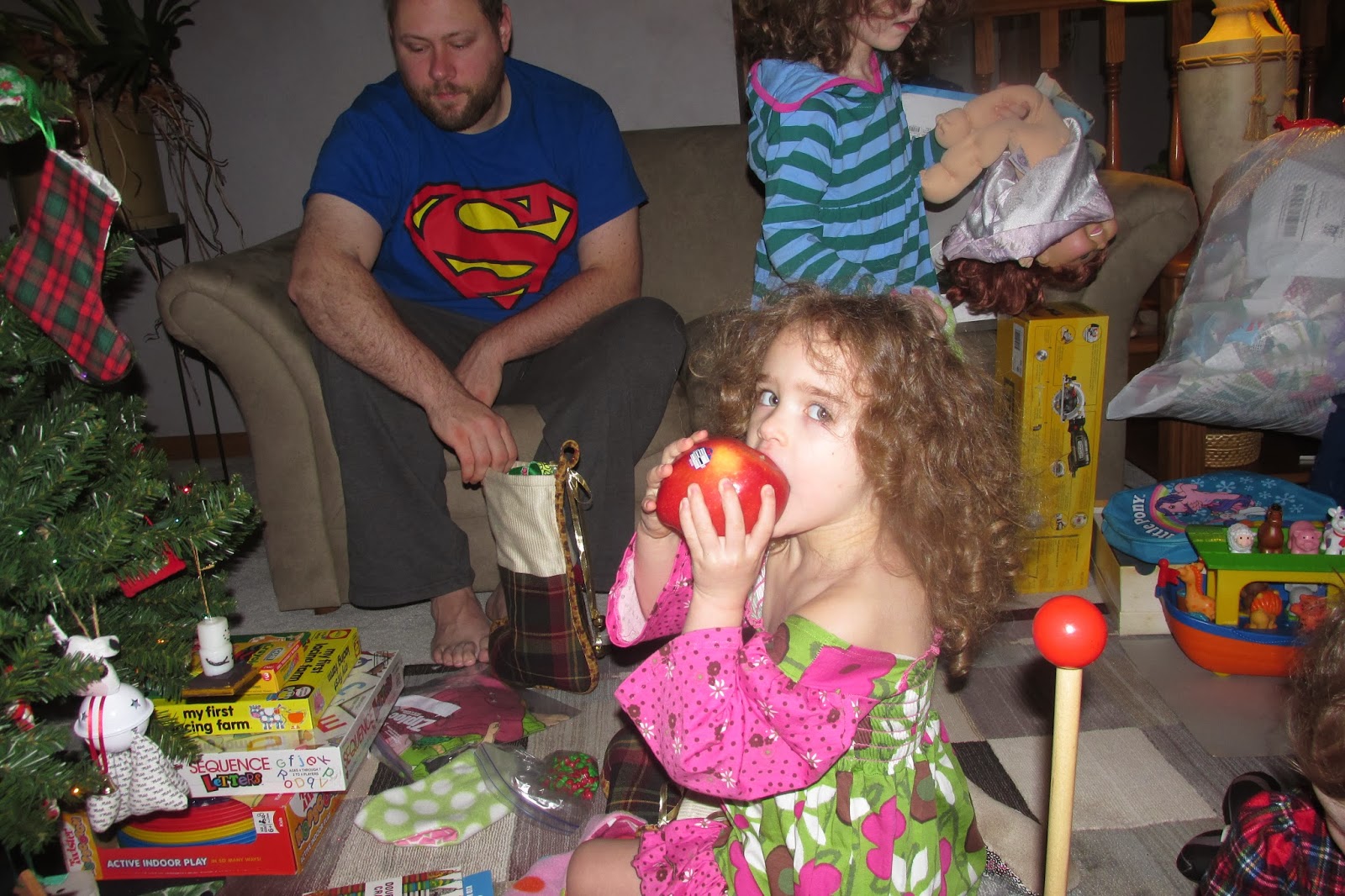
I did manage to take a few pictures. Of DD and SI playing their new harmonicas (SI is a natural). Of M and Grandpa putting the angel on the tree. Of my children continuing the only Christmas tradition I've ever started- actually eating the apples in their stockings on Christmas morning.

This year is was DD and RH. I'm very proud.
2013 was a long, exciting year. It was a year when I didn't get pregnant or have a baby, it was a year when we assured that I never would again. My children grew, and grew, and grew, and now here we are. Still a family. Still growing.

I've had a lot of chaotic, terrifying, or simply bad years in my life. More than my share, that is for certain. But 2013 was not one of them. For all its frustrations and irritations, this year has done more for me than many. It has done more than most. It has offered me a promise- the next year will only be better.

I wish that promise to all of you. For every year.

Tonight I'm going to mash some potatoes, drink some champagne, and hug my children tightly when I say goodnight.

Tonight I'm going to welcome the new year with old friends, with favorite pastimes, with laughter and promise.

And of course with more Batman stuff than you can shake a stick at.
Thank you for everything, 2013. I will not miss you, I have no doubt 2014 will keep me too busy for that. But I am grateful. And I will always look back to 2013 as a good year, when everyone was happy, and everyone was loved, and the world was full of magic and joy.

Happy New Year.

December 9, 2013

It's Beginning To Look A Lot Like...

My little ballerinas
Well, not in our house, yet. I've been reminding M to bring up the tree from storage for more than a week, but go figure- the Christian can't be bothered.

That said, Christmas is seeping in around here. SI is VERY disappointed it didn't start the day after Channukah ended, but she admits that waiting another two weeks isn't that big a deal. The kids are thrilled that I've mounted our wreath on our door, and they've started receiving warnings from their father that Santa Claus is watching.

And most excitingly of all- my great aunt and great uncle took us to see "The Nutcracker" at the Joffrey Ballet this past weekend.

DD and SI eating popcorn with their great-great-aunt and uncle
There are some things about Christmas that, yes, even as a Jew, I love. The Nutcracker is one of them. Ever since my childhood best friend had a Nutcracker themed birthday party what feels like eons ago, I've been hooked.

Source
And the Joffrey Ballet is world class dancing. Truly. It was nearly as magical for me as it was for the kids. DD sat on the edge of her seat- staring wide eyed and gape jawed at the dancers. SI grabbed my shoulder and pointed wildly every time a familiar character or plot twist appeared, grinning and throwing herself into her great-great-uncle's arms.

Source
DD's favorite part was when the toy nutcracker turned into a dancer (I also LOVED that). SI's favorite part was the doll with all the children underneath. (Yeah, that was pretty spectacular too.)

Source
M's favorite part was the Arabian dance, and I'm on the verge with agreeing with him myself. It was, to put it mildly, stunning.

Source
But I think my favorite part was how completely, un-self-consciously ELATED my children were. How they floated on air from the moment they put on fancy dresses and learned some basic positions from M (who used to dance competitively), to the awe on their faces as they listened to the child choir caroling in the lobby, to their shock as we passed the Santa Shuffle 5K downtown, and they saw HORDES of rovings Santas on the street, to DD's shock at being "bitten" by the Nutcracker outside the show. (SI lifted the lever while DD's fingers were exploring his teeth.

"Mommy! The Nutcracker BIT me!"

Despite missing out on the actual show, even RH caught ballet fever for the day.


It was a magical day.

I'm sure none of us will ever forget it.


---

And hey! Guess what? I'm guest posting over at Raised on the Radio today! Come check out my mix tape- Amazons of Rock!

October 21, 2013

I Don't Believe In Gita


Jen KehlIt's mix tape Tuesday again! Today's theme? Spiritual Songs.

I have an odd sense of spirituality. Well, that's not exactly true. I'm very much an American Jew. It's a breed of spirituality that can be very hard to explain to Christians.

Christianity is very much connected to a sense of afterlife. A belief in at least Heaven, if not Hell. Jews... don't have that.

We believe that when you die, your body goes into the ground to wait for the messiah. And when the messiah comes, you take a nice hike to Jerusalem.

...that's an oversimplification, but it's the basic gist of it.

Yes, there is talk of Heaven and Hell, but not as places that you go. Hell is the sort of place reserved for the occasional demon or really really really really really really really bad person. I mean, you've got to work at it if you want to go there. You've got to be REALLY evil.

And as for Heaven, well, if you're really really really really really really really good...

See, we don't care too much about the afterlife, as Christians see it. We care VERY much about our day to day, and we care about when the messiah comes.

And you only get to take that nice long walk to the Holy Land if a)you're Jewish, b)you're buried according to Jewish law, and c)the messiah has arrived.

Many modern Jews are skeptical of this idea. That long, long, long after you're dead, you and every other dead Jew there ever was will cram into Jerusalem... well... it's going to be very crowded, isn't it?

And if you don't really believe in Heaven or Hell, or even an abstract description of a delayed afterlife, it's hard to describe yourself in America as "religious." Recently a report came out on the status of Jews in America, and a lot of people were surprised or upset at the results. Many Jews didn't describe themselves as religious, in fact most of them are pretty explicitly atheists. But for us, that's not really a contradiction.

Of course, there are TONS of Jewish people who, if called by a stranger and asked, "So, are you REALLY Jewish? I mean, REALLY Jewish? We're making a list..." Those Jewish people would say, "Oh no, I'm not, don't mind me, just another harmless atheist..."

The fact is, you can be Jewish without believing in God. And you can be Jewish without believing in Heaven or Hell. But it makes Jewish spirituality hard to define.

Jewish spirituality is based in a connection with history, first and foremost. The admonition for Yom Ha'shoah, "Never Forget," doesn't just refer to the Holocaust. It's all of Jewish history. You know that scene in "The Big Lebowski" where Walter explains being Jewish? (1:19)


Ah, the zeal of the convert. But he's right- we're all living in the past. And most varieties of spirituality are about the future. About the afterlife. About the next astral plane.

So is there a point to a religion that doesn't tell you, "Be good and you'll be rewarded. Be bad and you'll be punished," in the real world? I've been asked many times, how does that provide a moral compass? What stops you from killing and stealing and coveting all you want?

Well, there is morality to a spiritual doctrine that doesn't include punishment and reward. And it's one that tells you you are better than any of those urges. (Yes, Judaism is very much about Jewish exceptionalism. I mean, we call ourselves "The Chosen People.")

And the result? I do kill and steal and covet as much as I want. And as much as I want is essentially zero. No fear of eternal damnation required.

At any rate, this list is about spiritual songs. Songs that I find spiritual, for some reason or other. Songs that move me, in a spiritual way. And here they are:


Just as I was saying... I am responsible for my own actions. I am responsible for my own fate. My parents and spiritual upbringing helped instill in me a moral compass that guides me, as Nina Simone says, and if I have no capacity to use those tools, it is my own fault. This is the only song on the list you might generally be able to call a "spiritual."


Spirituality is something difficult to put into words, so I have no trouble including a completely wordless song in my collection of spiritual music. There is something about this that simply moves me. I have waxed rhapsodic about this particular piece of music before... but this clip is THE BEST. Why? Because that conductor IS Stravinsky. That's him, conducting what might be the most transcendent piece of music ever written.

When it comes to the end, you can see in his face... the emotions... the emotions that have brought me to tears every time I hear this music (particularly the start of the last movement- starting about 4:30), since the first time, when I was seventeen and had to pull my car to the side of the road because I was weeping at the wheel. And there is nothing more spiritual for me than the wealth of human emotion, and our ability to share it.


Spirituality is, to me, what connects you with a deeper sense of purpose, or meaning. And this song is that for me. It's not about life and death, it's just about life. And this song kind of saved my life. I know, that sounds melodramatic. But it's true. It pulled me from a depression as deep as any I've ever known. And that's enough to make a convert of most people. Me? I was just born again an Ani fan.


"God is a concept by which we measure our pain." Do I believe this? Sometimes. Sometimes I believe in God as a single entity. Sometimes I believe in God as the unifying benevolent nature of existence. Sometimes I believe in God as the name we give to fate. And sometimes I don't believe in God at all. But the real message of this song isn't that there is no God, it's that life, all of existence, only has the meaning that you give it. And for John, as for me, the deepest meaning that you can give your life is to dedicate it to love.


Kol Nidre is one of the most important prayers in Judaism. As the Torah was originally an oral tradition, when it was transcribed, thousands of years ago, it was transcribed the way it was told... in song. The entire of the Torah (the Old Testament) is written in song. And Kol Nidre isn't in there, it's a separate prayer. It's the prayer you say before reading the Torah on the eve of Yom Kippur. The music has always moved me, and its meaning moves me still more. "With God's permission and the permission of those around us, we hold it lawful to pray with sinners."

Every word is an acknowledgement that we are flawed, and that our flaws are our own responsibility. And the prayer continues as an acknowledgement that we will continue to be flawed. That despite the knowledge we have of our own faults, we will repeat them. It's humbling to say those words. To say, "I am flawed, and I am sorry, and I will try to change and I will fail. And next year, I will be here again." And I do believe that humility is a fundamental property of spirituality.

Spirituality must dictate that you are less than the other, than the unseen, than the holy, than the unknowable. You are a speck of dust in the universe. You are one of billions of people on the earth. You are one of countless creatures in existence. You are less than this creation, or anything that might have been instrumental in creating it.


And there you have it. My spirituality, in five songs.


A note to my Jewish readers who would like to disagree with me on my interpretation of our faith... I welcome all your comments! Just keep in mind our rich heritage of philosophical and theological disagreements- remember the ten plagues! I mean fifty! I mean a hundred and fifty!

August 26, 2013

Race in America - End of the Month Controversy

Talking to my kids about difficult subjects
All this talk about Mily Cyrus at the VMAs and cultural appropriation has me thinking back to a subject I have wanted to discuss for a long time. (So no, this isn't a post about twerking. Sorry.)

The thing is, race is an incredibly difficult thing to talk about. I'm much more comfortable talking about general otherism, about the reality of privilege, or about economics and class than I am talking about race.

Race is something I've always found it difficult to wrap my head around.

You see, I am not white. That might come as a shock to you. I'm Jewish. Oh yes, I can pass. Lots of Jews can pass. And just as many, if not more, can't.

I have two biological sisters. My older sister is paler than me, but she doesn't pass as well. That's because of her hair- her hair that is indisputably ethnic. My younger sister doesn't pass as well either. That's because her skin is so dark that she's sometimes mistaken for Middle Eastern of non-Jewish descent, which can be particularly awkward when it's a Palestinian who's making the mistake.

Me, Aunt Genocide, Aunt Something Funny
But I pass, mostly. I've got blue eyes and pale skin. So I "pass."

But I've known I've been "passing" my whole life.

I've known since I was very little that I wasn't white. It's one of those things, people don't experience privilege unless they're excluded from it. Part of privilege is that you're "normal" from the get-go. When you're not part of it, you're a novelty.

I was the freaked out kid at the pool who all the middle aged white ladies surrounded, to take turns touching my hair without permission.

I was the good natured token Jew, listening to every story about every other Jewish person anyone else in the room had ever met.

At nine years old I sat on the floor with my best friend in the wee hours of the night, patting her shoulder and trying to comfort her through her paroxysms of grief that I was condemned to Hell and she would have to go to Heaven without me someday unless I could somehow stop being Jewish.

I am not white.

I am also not black. I do not share the universal cultural experiences of being African American. I don't have to choose between demanding equal treatment or being an "angry black lady," I've never been pulled over without cause, I'm not faced daily with the cultural appropriation of my incredibly large and visible minority by the even larger and disproportionately more visible white population.

But I am enough other to both to have experienced some of being either.

Being white isn't just about having pale skin and fine hair. Being white is about being the standard. About how any deviation from that standard is bad, and you are less accepted and even tolerated for it.

But being white also means that you have a pervasive ignorance of the experiences outside your privilege. This is something I know. When I was thirteen, I was playing a game with some theater friends of my older sister. I was pretending to be an alien, doing research on humanity. I asked her friend, an African American man, to describe his family. He told me he was raised by his mom. I asked if that was typical. He said yes, and I was shocked. And then I got a lecture from him, as well as another friend of his (also male and African American) about the dearth of male father figures in their communities. In their childhoods.

Although at thirteen I didn't exactly have the words for it, I saw my white privilege for the first time.

(And really, if you are not familiar with this particular social issue- take three minutes and watch this video. I'll wait.)


So even though I'm not white, I know what white privilege is.

But I still have a hell of a time talking about RACE.

I can say to my kids, "Part of who we are is persecution. Our entire Jewish culture is based on a history of fleeing Inquisitions, Crusades, genocides, pogroms... Every holiday we celebrate is under the cloud of five thousand years of otherness. When Columbus sailed to the New World, your ancestors were fleeing his homeland for the Netherlands with nothing but the shirts on their backs. When the Founding Fathers signed the Declaration of Independence, your ancestors fled Polish persecution for Israel. When the Civil War threatened to split your country, your ancestors were fleeing a genocide in Russia. When your great great grandfather came to this country, he would never see his family back home again- they would all perish in the Holocaust. And when your family came to this country, they were not welcome, in the way you feel now, mostly. They were other, Christ Killers, hook-nosed yids, traitorous money-lenders. That is how the country we love and call home saw them."

And I do love this country. Truly. And I am grateful for it, and to it. And it is my obligation to help it continue to grow and mature and change for good. And part of the debt I give my country is my children.

American children.

Children who, unlike me, have a white parent.

DD, she has my older sister's ethnic hair. She has my younger sister's dark complexion. She will not pass as well as me, and definitely not as well as her twin sister- who has finer hair, bluer eyes, lighter skin than I- who so nearly "pass."

So what do I tell my children about race?

I don't know what box to check. I'm not Caucasian, I'm more Middle Eastern. But realistically, I'm not Middle Eastern, either. I'm not non-white Hispanic, I'm not Asian or Pacific Islander, I'm not Native American.

The only box I can check is "Other," and write in, "Jewish."

Because race isn't about the color of your skin. Not always. But it's also about that.

When my three year olds tell me that their friend from school has a big sister with pretty brown skin, so when THEY'RE big girls, THEY will also have pretty brown skin, I bite my tongue.

I don't want to tell them they're wrong, because they'll figure that out on their own. Because I don't want to be the person responsible for making them suddenly see that there is a difference beyond the superficial in the color of their skin and another person's.

I don't want to be the one to put the words of privilege into their vocabulary. But even more, I don't want to leave them unprepared to ignore the words of bigotry and hatred.

I have long come to terms with the idea that it will fall upon me to explain anti-semitism to my children. The pervasive anti-semitism of a largely "accepting" majority Christian culture.

I've already had to explain that I don't want to watch Sesame Street today, because of shit like this:


That reminds me all too plainly of shit like this:


And this:


So, yes, I definitely want to direct this conversation with my kids. I want them to know that people are different, and that's GOOD. That people have different kinds of skin and different kinds of hair and different kinds of faces and different kinds of genitalia and different kinds of histories and different kinds of intellectual ability or disability, and the endless variations of humanity are a testament to how amazing we all are.

But I also want to explain to them, before somebody else does, that some people still see something else when they see somebody's brown skin, or kinky hair, or long nose.

I want to be the one to explain to them that, because they have light skin and light eyes, people will be nicer to them. Almost universally. And that as nice as it might be, it's wrong.

But I don't want to have these conversations, because they are based in a truth that can't be hidden, and can't be candy-coated.

I don't want to be responsible for showing my children that racially motivated hatred exists. I don't want them to start thinking of people in terms of race, because with racial awareness comes judgement.

But at the same time, they need to be aware of people's cultural and racial experiences. They need to know why certain behaviors are unacceptable- yes, including Miley Cyrus's twerking. They need to know that racial experiences are different, and that difference does not imply relative worth.

I have no idea how I'm going to have those conversations. There is no guide book to discussing race in America with half-white, non-black children.

It's far too nuanced and delicate a subject for any one book to handle.

But it is essential. It is essential to teach our children that racial biases exist. It is essential to teach them that our culture, as a whole, embraces them. That if they're not careful, one day they'll realize that they trust white skin on sight, and don't trust brown. Or that they'll expect every news report about a criminal to be about a person of color. Or that they'll be surprised when the bad guy in their movie doesn't have darker skin and coarser hair than the good guys.


I want my children to see these messages for what they are- ignorant assumptions made by a class that is spoon fed privilege from the day they're born.

I am in charge of making sure this is the message they receive. I need to take ownership of that. I need to make sure I raise people, American citizens, who don't accept their privilege.

The only way to end this culture of privilege is to ensure that those who benefit from it reject it. That when we are in the position of privilege and somebody else is struggling through persecution, we stand up and take ownership. I want to know that someday, if my kids see that their brown-skinned friends are being treated differently than them, they will approach the culprit and demand an explanation.

That is the debt I owe to a society that has largely accepted me as one of its own.

But I also want them to point out their differences when they are ignored. Point out the hurt it does when their culture is appropriated. I want them to take pride in their uniqueness, in their racial and cultural heritage.

And the best way to teach a child anything is to set an example.

And so I charge you, every one of my lovely readers, to step back from your life for a moment and look for the privilege you experience.

Do you know that you have a place to worship, no matter where in the country you might move?

Do you know that you will get fair pay for your work?

Do you know you can call the police if you are in need and they will see you as an innocent victim?

Do you know that if you speak the language of your childhood home, you will be understood?

These are privilege.

Be aware of it. And consider what it feels like to answer "no" to any one of those questions. To all of them.

The burden of educating my children on race and privilege doesn't fall only on me, it is ours as a culture. My lessons mean nothing without the contrast of reality, or the television they watch and the people they meet and the pictures on magazines on the rack at the grocery store.

It's time we all took some responsibility for that.

LinkWithin

Related Posts Plugin for WordPress, Blogger...

Vote for me!

Visit Top Mommy Blogs To Vote For Me!